



The Universe's Biggest Puzzle
For decades, scientists have known that something is missing. When they observe galaxies, they see them spinning so fast that, based on the visible matter like stars and gas, they should fly apart. The gravitational glue holding them together comes from
an invisible substance called dark matter. It's thought to make up about 85% of all matter in the universe, yet we have never seen it or detected it directly. Its existence is inferred purely from its gravitational effects on the things we can see. This has made identifying dark matter one of the most significant challenges in modern physics. Dozens of candidates have been proposed, from hypothetical particles like WIMPs and axions to more exotic ideas.
An Old Idea: Primordial Black Holes
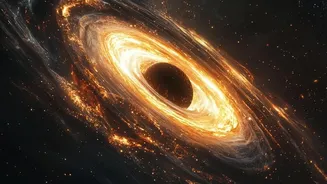
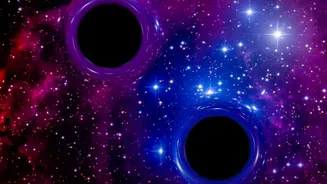
One of the most intriguing possibilities is that dark matter is made of primordial black holes (PBHs). First proposed by Stephen Hawking and Bernard Carr in the 1970s, this theory suggests that in the chaotic first moments after the Big Bang, tiny, dense pockets of matter could have collapsed directly into black holes. Unlike the black holes we know that form from collapsing stars, these primordial ones could have a vast range of sizes, from smaller than an atom to many times the mass of our Sun. Because they are black holes, they would be invisible and interact with their surroundings almost exclusively through gravity, making them a perfect candidate for dark matter. This idea elegantly solves the dark matter problem using an object we already know exists, just in a different form.
What the New Findings Show
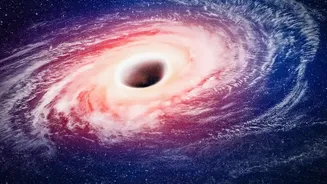
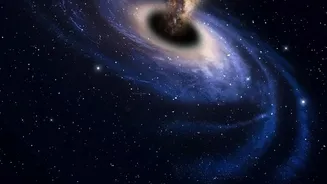
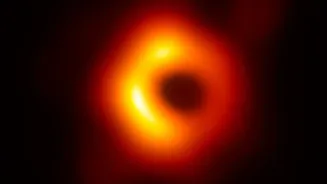
The latest research doesn't look for tiny primordial black holes directly. Instead, scientists have turned their attention to their giant cousins: supermassive black holes found at the centers of galaxies, and even a hypothetical class of 'stupendously large black holes'. A recent study investigated whether a significant portion of dark matter could be composed of these enormous black holes, objects weighing more than 100 billion times the mass of the Sun. The logic is that if dark matter consists of these massive objects, the universe would have a 'grainy' texture on a large scale. The scientists analysed the cosmic microwave background—the faint afterglow of the Big Bang—to look for evidence of this graininess. They found none, suggesting the universe is smoother than it would be if these giant black holes were a major component of dark matter.
Connecting the Dots on Dark Matter
While the study focused on stupendously large black holes, its implications ripple down to the broader primordial black hole theory. The smoothness of the early universe's light signature puts tight constraints on how many massive objects could have been floating around. If the universe was packed with a huge number of smaller, planet-mass primordial black holes, some of them would have likely grown over billions of years into the very 'stupendously large' objects the study has now largely ruled out as a primary dark matter component. Essentially, by not finding the 'adult' versions of these black holes in the numbers required, it makes it less likely that the 'infant' versions (the smaller primordial black holes) could be responsible for all of the dark matter we detect today. The findings don't completely eliminate PBHs as a candidate—especially very small ones—but they significantly narrow the possibilities. The theory that all dark matter is made of PBHs now faces a serious challenge.