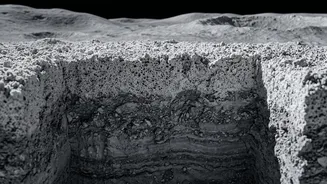







A Fluffy, Three-Layer Cake
Imagine stepping onto the Moon and finding the ground isn't uniform dust, but a layered structure like a cake. That’s essentially what scientists have discovered at Shiv Shakti Point, Vikram's landing site. A new study published in 'npj Space Exploration'
details a fascinating, three-tiered profile just within the top 10 centimetres of the lunar regolith, or soil. The very top layer, extending down about 3 cm, is exceptionally porous with a porosity of 80%—meaning it's mostly empty space. Beneath this 'fluffy' layer, from 3 to 6 cm, lies a second, more conductive layer. Deeper still, from 6 to 10 cm, is a third, even denser layer. This complex, fine-scale layering was neither expected nor previously observed, challenging long-held assumptions about the lunar surface.
How ChaSTE Uncovered the Secret
The discovery was made possible by a key instrument aboard the Vikram lander: the Chandra’s Surface Thermophysical Experiment, or ChaSTE. This instrument features a probe that penetrated nearly 10 cm into the lunar soil, equipped with ten temperature sensors along its length. By measuring the temperature at different depths and how quickly the soil heated and cooled, scientists could determine its thermal conductivity. From there, they could infer crucial physical properties like density and porosity. This provided the first-ever direct, in-situ thermophysical profile of the Moon's southern high-latitude region, offering a level of detail that remote sensing from orbiters simply cannot match.
A Surprise Assist from a 'Hop'
Interestingly, an earlier phase of the mission provided crucial comparative data. Towards the end of its mission, the Vikram lander famously performed a 'hop' manoeuvre, firing its engines to lift off and land about 50 cm away. This action blew away the top 2-3 cm of loose dust at the new site, exposing the more compact layers underneath. Initial analysis of this post-hop location revealed a two-layer structure. The new, more comprehensive study analysed data from the original, undisturbed landing spot, which allowed scientists to characterise the complete three-layer profile, including the incredibly porous topsoil that was blown away during the hop. ISRO has described the difference in density as akin to an astronaut walking on dry flour versus damp, stiff clay just a few centimetres deeper.
Why a Porous Surface Matters
This discovery is more than just a geological curiosity; it has profound implications. The highly porous top layer acts as an incredibly effective thermal blanket. Data showed a startling temperature gradient of about 73 degrees Kelvin between the surface and a depth of just 10 cm at lunar noon. This insulating property is critical because it could help preserve subsurface water-ice from vaporising, even in areas that receive some sunlight. Understanding how the lunar surface traps and transfers heat is fundamental to figuring out where resources like water might be stored, a key goal for future exploration.
Designing the Future of Lunar Living
The findings have immediate practical consequences for future lunar missions, especially those involving construction. Knowing that the lunar soil changes from light and fluffy to dense and sticky within just a few centimetres is critical for designing landers, rovers, and habitats. Any structure built on the Moon will need to be anchored in the firmer, more cohesive sub-layer, rather than resting on the unstable, porous topsoil. This detailed understanding of the regolith's mechanical properties, provided by Chandrayaan-3, will directly inform the engineering and site selection for the scientific bases and infrastructure that nations, including India, hope to build on the Moon.