





Hunting for the Unseen
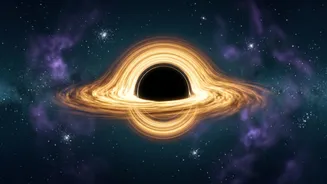
Astronomers estimate there could be over 10 million, or even up to 100 million, stellar-mass black holes in our Milky Way galaxy alone. Yet, we've only managed to identify around 70 so far. The vast majority are 'quiet'—not actively feeding on nearby
stars, which would make them glow in X-rays and thus easier to spot. To close this massive gap, the Black Hole Hunters project was launched on the Zooniverse platform, inviting anyone with an internet connection to join the search. The project, co-led by Dr. Adam McMaster of the University of Southampton, empowers volunteers to comb through vast datasets and identify potential candidates that professional astronomers can then investigate further.
The Science of Gravitational Lensing
So, how do you find something that is, by its nature, invisible? The project relies on a fascinating phenomenon predicted by Albert Einstein: gravitational lensing. A black hole's immense gravity is powerful enough to warp the fabric of space-time around it. If a hidden black hole in a binary system (orbiting a star) passes directly between its companion star and Earth, its gravity acts like a magnifying glass. This 'lensing' effect briefly amplifies the star's light, causing a distinct spike in its brightness. Volunteers are tasked with looking at graphs of star brightness over time, called light curves, and spotting these characteristic peaks. The data comes from powerful instruments like NASA's Transiting Exoplanet Survey Satellite (TESS), which is designed to detect tiny changes in starlight.
Why Human Eyes Still Beat AI
In an age of advanced algorithms, it might seem odd to rely on human volunteers for such a cosmic search. While automated systems do an initial sweep of the millions of light curves, they often struggle with the 'messy realities of the cosmos'. Natural stellar flares or the normal pulsations of a star can mimic the signal of a lensing event, creating false positives that trick the AI. Human pattern recognition, however, is exceptionally good at distinguishing these subtle differences. Volunteers are shown examples of what to look for, making the task a simple matter of pattern recognition that requires no prior expertise. This human touch is crucial for creating a clean, reliable shortlist of promising candidates for scientists to follow up on.
The Power of the Crowd
The response to Black Hole Hunters has been immense, validating the power of citizen science. Since its modern iteration began, nearly 23,000 volunteers have contributed, making almost 12 million classifications of star data. This collective effort accelerates a process that would take a small team of professional astronomers years to complete. Projects like this are part of a growing movement in India and around the world. Initiatives like RAD@home, the first Indian citizen science astronomy program, and projects from the Pune Knowledge Cluster, similarly empower students and the public to participate in real research, from analysing galaxy data to monitoring the environment. It demonstrates a shared global curiosity and the incredible potential of harnessing public enthusiasm for scientific discovery.
How You Can Join the Hunt
Getting involved is straightforward. The Black Hole Hunters project is hosted on Zooniverse, a well established platform for citizen science. Aspiring hunters can visit the project's page, where they will find a simple tutorial and examples of the light curve patterns they need to identify. As project co lead Adam McMaster has stated, it is a simple task that requires no special knowledge, and every participant could be the one to help discover a new type of black hole system. By flagging these potential discoveries, volunteers play a direct role in guiding where powerful telescopes will point next, making a tangible contribution to our understanding of the universe.