


A Breakthrough in Solar Imaging
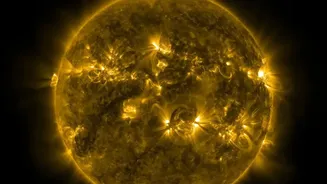
In a remarkable feat of astronomical observation, scientists have captured the most detailed images of the sun's surface to date. Using the powerful Daniel K. Inouye Solar Telescope in Hawaii, researchers have made visible tiny, swirling vortices of plasma
that were previously undetectable. Some of these newly seen structures are as small as 20 kilometres across, an incredible achievement in resolution that has been compared to spotting a small coin from 180 kilometres away. These images, published in the journal Nature, reveal wave-like and spiralling patterns at the edges of solar granules—the vast, bubbling cells of plasma that cover the sun's surface. This discovery provides a direct look at a phenomenon that was only theoretical until now, opening a new chapter in solar physics.
Meet the Kelvin-Helmholtz Instability
The newly observed plasma swirls are interpreted by scientists as evidence of a process known as Kelvin-Helmholtz instability. This is a fundamental concept in fluid dynamics that occurs when two fluids, or in this case plasmas, flow past each other at different speeds. This difference in velocity creates a shearing force at their boundary, causing small disturbances to grow into the curling, wave-like vortices now seen on the sun. While this instability is seen in many places, from ocean waves and clouds on Earth to the atmosphere of Jupiter, it had never been directly observed on the sun's surface. The new observations confirm that this process is happening constantly at the boundaries of the sun's magnetic regions, converting the kinetic energy of flowing plasma into magnetic tension.
Solving the Sun's Greatest Puzzles
Observing these plasma waves provides a powerful new tool for helioseismology—the study of the sun's interior by analysing waves on its surface. Much like how geologists use seismic waves to understand Earth's inner layers, solar physicists use plasma waves to probe the star's unseeable depths. The existence of these tiny vortices helps explain some of the sun's most enduring mysteries. For one, it provides a mechanism for the rapid transport of magnetic energy across the sun's surface and into its atmosphere. This could be a key piece of the puzzle in understanding the sun's 11-year activity cycle. Furthermore, the energy generated by these instabilities might help solve the famous coronal heating problem: why the sun's outer atmosphere, the corona, is millions of degrees hotter than its surface.
Why Solar Waves Matter on Earth
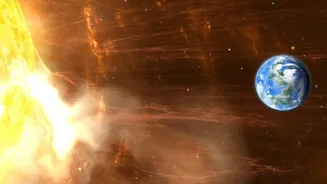
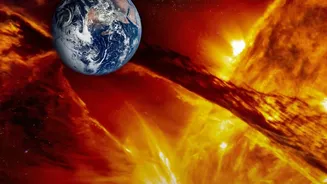
Understanding the sun's behaviour isn't just an academic exercise; it has profound practical implications for us on Earth. The sun drives space weather, releasing streams of charged particles and massive bursts of energy, like solar flares and coronal mass ejections. These events can disrupt our satellite communications, damage power grids, and pose risks to astronauts. The newly discovered plasma waves are believed to be linked to the buildup of magnetic energy that can lead to these large-scale explosions. By studying how these waves transfer and release energy, scientists can improve their models for predicting solar activity. This brings us one step closer to forecasting major space weather events, helping to protect our increasingly technology-dependent society. It also provides valuable context for India's own solar missions, like Aditya-L1, which are designed to study our star up close.