
A Universe in a Snapshot
The primary power of the Roman telescope lies in its incredible field of view. While it has the same size primary mirror as the Hubble Space Telescope—2.4 meters—its Wide Field Instrument (WFI) will capture an area of the sky at least 100 times larger
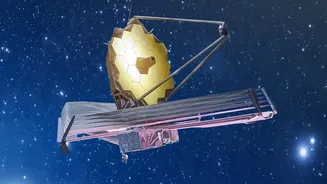
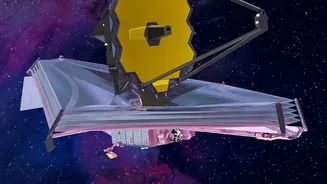
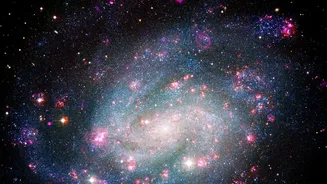
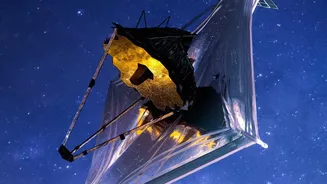
in a single shot. Imagine the difference between looking at the sky through a drinking straw versus a panoramic window. Where Hubble would need to painstakingly stitch together hundreds of images to map a small patch of sky, Roman will capture it all in one go with the same sharpness. Over its five-year primary mission, it’s expected to observe 50 times the area of sky that Hubble has in over 30 years. This 'wide-angle' approach makes Roman a survey telescope, designed to create a vast new atlas of the universe, identifying countless new objects for other telescopes, like the James Webb Space Telescope (JWST), to inspect in greater detail.
Shining a Light on the Dark
Two of the biggest mysteries in physics are dark energy and dark matter. Together, they are thought to make up about 95% of the universe, yet we know almost nothing about them. Roman's main purpose is to hunt for answers. It will tackle the puzzle of dark energy—the mysterious force causing the universe's expansion to accelerate—by mapping the cosmos on an unprecedented scale. The telescope will measure the precise distances to thousands of exploding stars, or supernovae, and chart the positions of billions of galaxies over cosmic time. At the same time, it will map the distribution of invisible dark matter by observing how its gravity bends and distorts the light from distant galaxies, an effect called weak gravitational lensing. By creating these enormous 3D maps, scientists hope to see how dark energy's influence has changed throughout cosmic history.
A Galactic Planet Census
Beyond the grand scale of the cosmos, Roman will also conduct the largest census of planets outside our solar system ever attempted. Its primary method will be a technique called gravitational microlensing. This happens when a star and its planets drift in front of a more distant background star from our perspective. The gravity of the foreground star acts like a lens, briefly magnifying the light from the background star. If that star has planets, they create their own smaller, detectable magnification spikes. This method is sensitive enough to find planets much smaller and farther from their star than other techniques can easily detect, including rogue planets that wander through the galaxy without a host star. Astronomers anticipate that Roman will discover thousands of new exoplanets this way, providing a crucial statistical understanding of how common different types of planetary systems are across the galaxy.
A New Kind of Vision
Roman is not a replacement for Hubble or Webb; it's a powerful new partner. While Hubble continues its detailed observations in visible and ultraviolet light and Webb peers deep into the infrared to see the universe's first moments, Roman will act as the great surveyor. It will identify the most interesting, unusual, and significant targets—from strange galaxies to potentially habitable worlds—for its sister telescopes to zoom in on. Roman also carries a technology demonstrator, the Coronagraph Instrument, which is designed to test new ways of directly imaging planets by blocking the overwhelming glare of their stars. This is a critical step toward future missions that could one day analyze the atmospheres of Earth-like worlds for signs of life. The sheer volume of data Roman will generate—about 1.4 terabytes every day—will be a goldmine for astronomers for decades to come.