






A Delicate Dance in Orbit
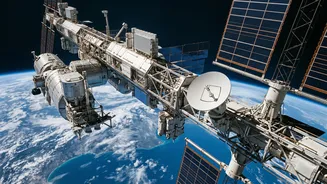
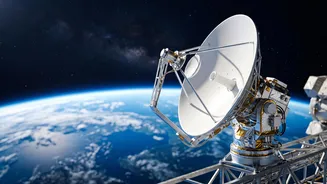
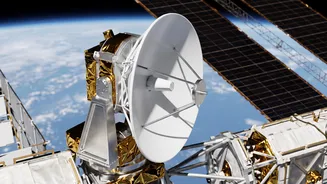
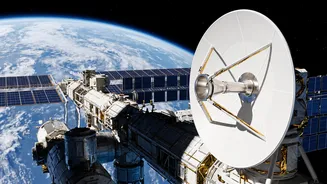
On Tuesday, NASA astronaut Anil Menon and European Space Agency (ESA) astronaut Sophie Adenot ventured out of the Quest airlock for a scheduled spacewalk. Their primary task was to install a new Space-to-Ground Antenna (SGANT), a vital piece of hardware
that ensures a high-speed data connection between the orbiting laboratory and Mission Control in Houston. The operation, which began at 8:27 a.m. EDT and concluded at 2:57 p.m. EDT, lasted six hours and 30 minutes. This was the second spacewalk for the pair to address the issue; an outing on August 18 saw them successfully remove the faulty antenna, but they ran out of time to install the new one due to difficulties with stubborn bolts and cables. During this week's spacewalk, Menon, serving as the lead spacewalker, was maneuvered into position by the Canadarm2 robotic arm while Adenot traversed the station's exterior using handrails to assist. The mission was the 283rd spacewalk in support of ISS maintenance and upgrades.
The Critical Communications Link
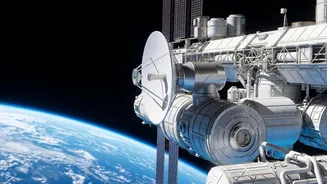
The newly installed antenna isn't just a spare part; it's a lifeline. The S-band antenna is a critical link that enables high-speed data, video, and voice communication between the station and Earth. This connection is essential not only for the crew's contact with their families and flight controllers but also for transmitting the vast amounts of data generated by the scientific experiments conducted on board. NASA and other space agencies rely on the S-band frequency for its reliability. Operating in the 2-4 GHz range, its signals are highly resilient and can penetrate weather conditions like rain and clouds that might disrupt higher-frequency bands. This makes it the go-to choice for mission-critical telemetry, tracking, and command (TT&C) communications — the constant 'heartbeat' that tells ground control about the station's health and status. Having a fully functional spare installed ensures redundancy, a core principle of spaceflight that protects against single points of failure. Initial checkouts confirmed the new antenna is showing good power and data transmission.
A Partnership Above the World
This successful mission highlights the deep and ongoing collaboration between international space agencies. The spacewalk was a joint effort between the United States' NASA and the European Space Agency, which represents 23 member states. Such partnerships are the bedrock of the International Space Station program, which was launched in 1998 and also includes Russia, Canada, and Japan. The ISS has been continuously occupied for over two decades, a feat made possible by sharing resources, technology, and expertise. This collaboration is often conducted through complex barter arrangements, where agencies exchange hardware, launch services, and research opportunities without a direct financial transaction. For example, ESA has provided hardware like laboratory equipment in exchange for NASA providing transport for European payloads and astronauts. This spacewalk, featuring an American astronaut and a French astronaut working seamlessly together, is a testament to the international cooperation that has defined the station since its inception. For Adenot, it was her second career spacewalk, while for Menon, it was his third.
The Hazards of Working in a Vacuum
While the astronauts and ground crews make it look routine, spacewalks, or Extravehicular Activities (EVAs), are among the most dangerous tasks an astronaut can perform. Outside the station, they are exposed to the vacuum of space, protected only by their multi-layered suits. Micrometeoroids and orbital debris, some traveling at speeds over 17,000 miles per hour, pose a constant threat. The astronauts also face extreme temperature swings, from over 120 degrees Celsius in direct sunlight to minus 160 degrees Celsius in the shade. The work itself is physically demanding, as astronauts must fight against the pressurised suit while performing intricate repairs with bulky gloves. The previous spacewalk on this same task illustrated the challenges when unexpected difficulties with connectors and bolts used up precious time. Every movement is carefully choreographed and rehearsed for hours on Earth in facilities like NASA's Neutral Buoyancy Laboratory to ensure the mission is completed safely and efficiently.