







The Illusion of Machine 'Thinking'
Generative AI tools are remarkably good at processing vast datasets, identifying patterns, and producing coherent text, code, or images. They can write an email, summarise a report, or analyse market data in seconds. But it's essential to understand that
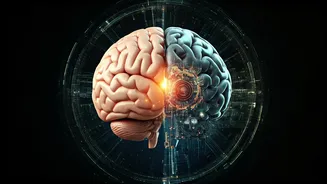
AI does not 'think' or 'understand' in the human sense. It is a sophisticated mimic, replicating patterns from the data it was trained on without grasping context, truth, or nuance. An AI can generate a legal-sounding document, but it has no concept of justice. It can write a marketing slogan, but it has no genuine creativity or emotional intelligence. This distinction is critical; we risk major errors if we mistake pattern-matching for genuine reasoning.
The Irreplaceable Human Element
Critical thinking is the set of skills that AI currently lacks. It's the ability to not just find an answer, but to question the answer. This includes evaluating the credibility of information, identifying hidden biases, understanding subtext, and applying ethical frameworks to complex decisions. A person with strong critical thinking skills can look at a situation from multiple angles, ask insightful questions, and distinguish correlation from causation. These are not just analytical skills; they involve creativity, empathy, and moral judgment—qualities that are inherently human. For example, while AI can analyse employee performance data, a human manager uses emotional intelligence to understand the story behind the numbers.
The Danger of Outsourcing Judgment
Relying on AI without a critical eye is a significant risk. Studies show that a habit of 'cognitive offloading'—delegating thinking tasks to AI—can lead to a decline in our own analytical skills. In the professional world, this can have serious consequences. Accepting AI-generated code without testing could introduce critical bugs. Using an AI's financial projection without questioning its assumptions could lead to disastrous business decisions. And because AI models are trained on existing data, they can inherit and even amplify historical biases, leading to unfair outcomes in areas like hiring or loan approvals if not carefully supervised by a human. The future is not about humans versus AI, but humans working with AI, where people provide the essential oversight and judgment.
From Information Overload to Actionable Insight
In the past, a key professional advantage was access to information. Today, with AI, information is abundant. The new bottleneck is insight—the ability to connect disparate pieces of information, identify emerging trends, and craft a unique strategy. This is where critical thinking truly shines. Professionals who thrive will be those who use AI as a research assistant, not an oracle. They will use it to handle the grunt work of data collection and summarisation, freeing up their cognitive resources to focus on higher-order tasks: strategic planning, creative problem-solving, and building relationships. For India's massive young workforce, this represents a huge opportunity to move up the value chain from performing routine tasks to providing high-level strategic guidance.
How to Cultivate Critical Thinking in the AI Era
For individuals and organisations in India, adapting is key. We must shift our focus from rote memorisation to active problem-solving. Educational institutions should embed critical thinking across all subjects, teaching students to question, analyse, and evaluate AI-generated content rather than just accepting it. Companies should invest in reskilling programmes that focus on these durable human skills. On a personal level, we can all practice by actively questioning the information we consume, seeking out different perspectives, and deliberately engaging in complex problem-solving without immediately turning to AI. By treating AI as a thinking partner to be challenged and interrogated, we can sharpen our minds rather than allowing them to atrophy.