





The Challenge of Finding Tiny Moons
For centuries, discovering Saturn's moons was a slow process. The first, Titan, was spotted in 1655. Finding others required bigger and better telescopes. The main problem is that Saturn is incredibly bright, and its moons are often tiny and faint. Any
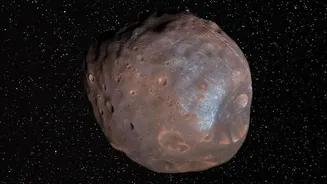
light from a small, distant moon is easily washed out by the planet's glare. Furthermore, these moons are moving targets, streaking across the sky as they orbit the gas giant. Before the advent of digital imaging, astronomers relied on long-exposure photographic plates, a method that successfully revealed Phoebe in 1899 but had its limits. For decades, tracking these faint wanderers against the backdrop of distant stars was a monumental task.
A Game-Changer: The 'Shift and Stack' Method
The recent explosion in moon discoveries is thanks to a clever digital imaging technique called 'shift and stack'. Instead of taking one long exposure, where a moving moon would appear as a blurry streak, astronomers take many shorter sequential images. They then use software to digitally shift each image, aligning them based on the moon's predicted path across the sky. When these shifted images are 'stacked' or combined, the faint signal of the moving moon is amplified, making it pop out from the background noise. Stationary objects like stars become streaks in the final combined image, but the moon appears as a clearer, detectable point of light. This method allows astronomers to find objects that are far too faint to be seen in a single exposure.
The Telescopes Behind the Discoveries
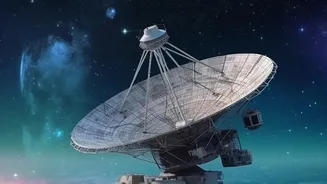
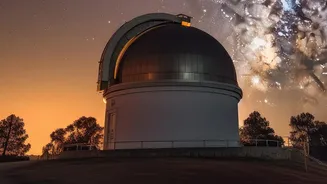
This groundbreaking work relies on powerful ground-based telescopes. An international team of astronomers, led by researchers like Edward Ashton and Scott Sheppard, has used facilities such as the Canada-France-Hawaii Telescope (CFHT) on Mauna Kea, Hawaii, to make these discoveries. The CFHT's large mirror and advanced cameras can capture deep images of the space around Saturn. By taking many images over a three-hour span, the team was able to detect moons as small as 2.5 kilometres in diameter. The Subaru Telescope, also on Mauna Kea, has been another key instrument in the search for faint, irregular moons around the gas giants. The data gathered by these observatories is meticulously analysed to not only spot potential moons but also to track their orbits over years to confirm they are truly satellites of Saturn and not just passing asteroids.
A Surge in Saturn's Moon Count
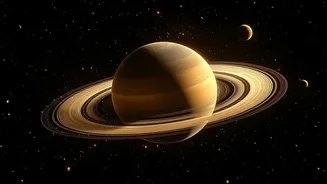
The application of the shift-and-stack method has dramatically increased Saturn's known moon count, pushing it far ahead of Jupiter as the 'moon king' of the solar system. In one campaign using CFHT data from 2019 to 2021, astronomers announced the discovery of 62 new moons. More recent confirmations in 2026 have pushed Saturn's total number of confirmed moons to over 290. Most of these new discoveries are classified as 'irregular' moons. This means they have large, elliptical, and inclined orbits, and many travel in a retrograde direction—opposite to Saturn's rotation. These irregulars tend to be clustered in orbital groups, suggesting they may be fragments of larger moons that were shattered by collisions long ago.
Why These Small Discoveries Matter
Finding these tiny, distant worlds is more than just a numbers game. These irregular moons are like cosmic fossils. Scientists believe they were not formed alongside Saturn but were instead captured by its immense gravity billions of years ago. By studying their orbits, sizes, and groupings, astronomers can piece together the chaotic history of the early solar system. They offer clues about the conditions when the giant planets were forming and migrating, and what materials were present in that region of space. Each new moon is another data point that helps refine our models of planetary system formation and evolution, telling a richer story about how our cosmic neighbourhood came to be.