
In our search for daily calm and physical relief, some of the most effective tools are the simplest. Apanasana, a foundational yoga pose, combined with controlled breathing, offers a powerful way to soothe both body and mind.
Understanding Apanasana: The Wind-Relieving Pose
Apanasana, often called the
'Knees-to-Chest Pose' or 'Wind-Relieving Pose', is a gentle, supine posture accessible to nearly everyone, from beginners to advanced practitioners. Its Sanskrit name gives a clue to its function: 'Apana' refers to the downward flow of vital energy ('prana') in the body, which governs elimination. The pose is designed to stimulate this downward energy, which is why it is celebrated for its ability to aid digestion, relieve gas, and reduce bloating. But its benefits extend far beyond digestion. By gently compressing the abdomen and lengthening the lower back, Apanasana provides a comforting release for tight lumbar muscles, making it a go-to for alleviating lower back pain caused by stress or long periods of sitting.
The Engine of Calm: The Power of Your Breath
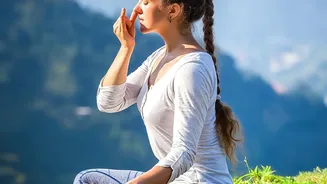
In yoga, the physical postures (asanas) are only one part of the practice; the other is pranayama, the conscious control of breath. The breath and the mind are deeply connected. When you feel stressed or anxious, your breathing often becomes shallow and rapid. Conversely, by deliberately slowing down your breath, you can directly influence your nervous system, activating the 'rest and digest' response that lowers your heart rate and promotes a sense of calm. The simple act of taking long, slow, deep breaths sends a powerful signal to your brain that it is safe to relax. When you synchronize this intentional breathing with movement, as in Apanasana, the benefits of both the posture and the breath are amplified, creating a moving meditation that soothes you from the inside out.
How to Practice: A Step-by-Step Guide
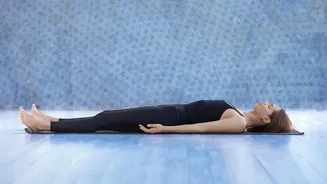
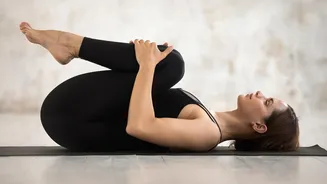
Finding comfort and stability in Apanasana is key. Follow these steps to perform the pose safely and effectively. 1. Begin by lying flat on your back on a comfortable surface, like a yoga mat. Allow your legs to be extended and your arms to rest by your sides. Take a moment to settle in. 2. Exhale, and gently bend both knees, sliding your feet flat on the floor toward your hips. 3. On your next exhalation, draw your knees in towards your chest. Wrap your hands around your shins, just below the knees. If this is uncomfortable, you can hold the backs of your thighs instead. 4. Keep your head, neck, and shoulders relaxed on the floor. Try to avoid lifting your tailbone too much; the goal is to lengthen the lower back. 5. This is where you sync your breath with subtle movement. As you inhale, allow your arms to straighten slightly, letting your knees float a few inches away from your chest. This creates space in the abdomen. 6. As you exhale, gently hug your knees back towards your chest, applying light pressure to the abdomen. Continue this gentle rocking motion, inhaling to release and exhaling to compress, for 8-10 breaths or for as long as feels good.
Key Benefits of the Practice
The combination of this pose and controlled breathing offers a wealth of benefits. Physically, it is a fantastic tool for managing mild lower back pain by stretching and decompressing the lumbar spine. The gentle pressure on the abdomen massages the internal organs, which can improve digestion and help relieve issues like bloating and constipation. Mentally and emotionally, the practice is deeply calming. The rhythmic nature of the breath and movement helps to soothe the nervous system, reducing feelings of stress and anxiety. It's an excellent posture to incorporate into a cool down after a workout, or as part of a bedtime routine to prepare your body and mind for restful sleep.
Modifications for Every Body
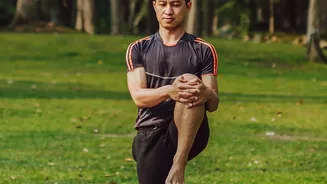
Yoga is about fitting the pose to your body, not the other way around. If the standard Apanasana doesn't feel right, try these variations : - One - Legged Apanasana (Ardha Apanasana) : If hugging both knees is too intense , practice with one leg at a time . Keep one leg extended on the floor (or with the knee bent and foot flat for more back support) while you hug the other knee to your chest . This is also a great option during pregnancy . - Wider Stance : If you have a larger belly or chest , you can separate your knees , drawing them towards your armpits rather than straight to your chest . This creates more space for your torso . - Use a Strap : If you have trouble reaching your shins , you can loop a yoga strap or a towel around your thighs to help you gently draw the knees in without straining your shoulders or neck .