






For centuries, Saturn's rings were a solitary wonder of our solar system. But robotic explorers completely changed that picture, revealing that all gas giants have rings, each with a personality and complexity we never could have imagined.
The View Before Our Robotic Eyes
Before the space
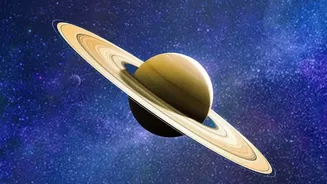
age, our understanding of planetary rings was almost entirely limited to Saturn. From Earth, even with powerful telescopes, they appeared as a set of beautiful, solid, and largely unchanging bands of light. When astronomers discovered faint, dark rings around Uranus in 1977 using a method called stellar occultation, it was a major surprise. This was followed by similar ground-based hints of rings around Neptune in the 1980s. But these were fleeting glimpses. No one was prepared for what our robotic emissaries would find when they arrived for an up-close look. The true nature of these systems—their intricate structures, their dynamic behavior, and their stunning diversity—remained a mystery waiting to be solved by photography from deep space.
Voyager's Grand Tour of Discovery
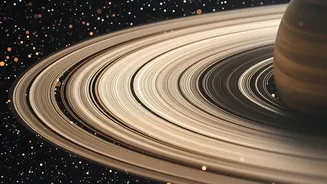
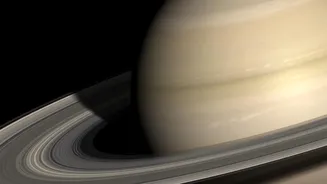
The game changed forever with NASA's Voyager 1 and 2 missions. As they flew past Jupiter in 1979, the probes sent back the first definitive images of its faint, dusty ring system, a structure scientists had long suspected but never confirmed. But the real revelations came at the outer planets. At Saturn, Voyager's cameras unveiled a breathtakingly complex system of thousands of individual ringlets, not just a few solid bands. They discovered strange radial features called 'spokes' that seemed to form and dissipate in hours, and saw the bizarre, braided structure of the F-ring, apparently held in place by two tiny 'shepherd' moons. Voyager 2's subsequent flybys of Uranus and Neptune were just as revolutionary. It provided the first-ever direct images of Uranus's 11 narrow, dark rings and Neptune’s five rings, including peculiar, clumpy arcs that defied explanation. The Voyager missions single-handedly transformed rings from a curiosity into a major field of planetary science.
Cassini's Thirteen-Year Masterclass at Saturn
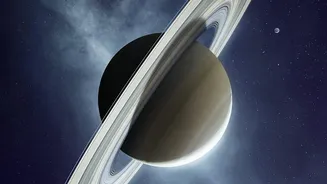
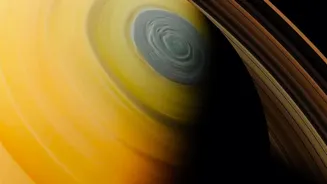
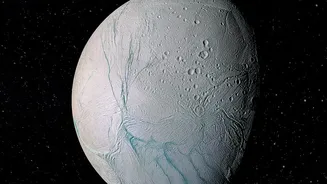
If Voyager wrote the book on gas giant rings, the Cassini mission, a joint NASA/ESA project, wrote the encyclopedia for Saturn. Orbiting the planet from 2004 to 2017, Cassini’s cameras provided a thirteen-year, front-row seat to the most complex ring system in our solar system. The discoveries were staggering. Cassini revealed that the rings were not flat, but had towering vertical structures, some as tall as mountains. It discovered tiny, mountain-sized moonlets embedded within the rings that create distinctive propeller-shaped disturbances in the surrounding particles, giving scientists a window into how planets might form in dusty disks around stars. Cassini's close-up shots showed an amazing variety of textures, with clumpy, streaky, and smooth zones with sharp, unexplained boundaries. It even found that the icy geysers from the moon Enceladus were the primary source of material for Saturn's diffuse E-ring, directly linking a moon's activity to the structure of the rings.
A New Family Portrait
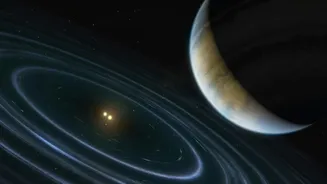
The legacy of these space probes is a complete re-evaluation of what planetary rings are. They are not static, ancient relics. Instead, probe photography has shown them to be dynamic, evolving systems shaped by a delicate gravitational dance between countless particles and the planets' many moons. Follow-up missions and observations have continued to build on this foundation. The Galileo spacecraft provided a more detailed look at Jupiter's gossamer rings, revealing they are formed by dust kicked off four small moons by micrometeoroid impacts. The Hubble Space Telescope later discovered even more rings around Uranus, doubling the known radius of its system. Each new image confirms the lesson first taught by Voyager: that the space around our giant planets is far more active and intricate than the view from Earth ever suggested, filled with structures that continue to puzzle and delight scientists.