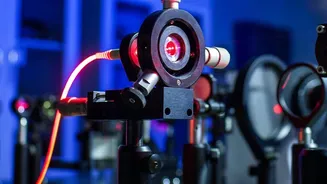







The Quantum Cold Case
The world of quantum mechanics is famously weird and powerful, built on principles like superposition, where particles can exist in multiple states at once. Harnessing this could lead to computers of unimaginable speed and sensors of incredible sensitivity.
But there has always been a massive catch: quantum states are incredibly fragile. At room temperature, the natural heat and vibrations of the world around us create a storm of atomic chaos. This 'noise' instantly shatters delicate quantum effects, a process called decoherence. The only solution has been to freeze everything to temperatures near absolute zero, using massive, expensive, and power-hungry cryogenic refrigeration systems. This has kept most quantum breakthroughs confined to the lab, far from practical, everyday use.
A Breakthrough Material by Design
Recently, a team of physicists from Louisiana State University announced a game-changing discovery published in the journal Nature. They developed the first material that can exhibit and transport quantum states at room temperature. Instead of searching for a naturally occurring substance, they engineered one from the ground up. The material is a 'plasmonic metacrystal', created by coating a glass chip with a whisper-thin layer of gold. Using focused ion beams, they then etched hundreds of microscopic slits into the gold surface. These tiny, precisely arranged openings act as 'meta-atoms'—artificial structures designed to manipulate light in ways no natural material can.
How It Works: Filtering Quantum Light
The genius of this new material lies in how it sidesteps the heat problem. Instead of trying to quiet down vibrating atoms, it focuses on manipulating photons—particles of light. As light travels across the gold surface, the carefully designed 'meta-atoms' act as a sophisticated filter. They can distinguish between different quantum states of light, directing them along separate pathways while preserving the fragile quantum information they carry. This is what the researchers call 'robust transport'. It maintains quantum coherence—the very property that heat usually destroys—without needing any cryogenic cooling. By carefully controlling the size, shape, and spacing of the microscopic slits, the team can engineer the material to perform specific quantum tasks.
From Lab Curiosity to Real-World Revolution
The ability to control quantum effects at room temperature is not just a scientific curiosity; it's the key to unlocking a technological revolution. Quantum computers could shrink from room-sized installations dependent on cryogenic coolers to more compact, practical devices. This could accelerate drug discovery, financial modeling, and materials science. It also paves the way for truly secure quantum communication networks. Beyond computing, the technology could enable ultra-sensitive sensors for medical diagnostics or environmental monitoring. The research team even plans to investigate if similar materials could boost the efficiency of solar cells, potentially contributing to renewable energy solutions.
The Road Ahead: Hype vs. Horizon
While this breakthrough is significant, it's important to set realistic expectations. The material developed by the LSU team is a proof of concept—a blueprint showing that room-temperature quantum control is possible. There is still a long journey from a single, specialized chip in a lab to mass-produced quantum devices in our phones or hospitals. Scientists will now work to refine these design principles, explore other materials, and figure out how to scale up manufacturing. This discovery hasn't solved all the challenges of quantum technology, but it has kicked open a door that was previously frozen shut, pointing toward a future where the bizarre world of quantum mechanics becomes a part of our everyday reality.