


First, It's a Confirmed Illusion
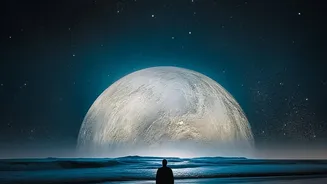
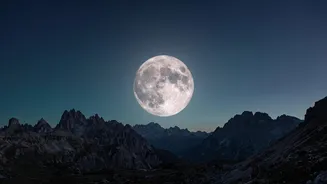
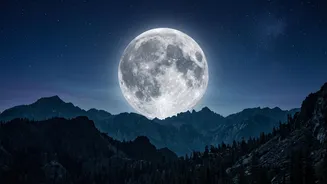
Let's get one thing straight: the Moon isn't actually changing size. In fact, due to the geometry of Earth's rotation, the Moon is slightly farther away when it's on the horizon compared to when it's directly overhead. If anything, it should look a tiny
bit smaller, not larger. You can prove this yourself. The next time you see a giant horizon moon, hold a small object like a pea or a pencil eraser at arm's length. You'll find it covers the Moon just as easily as it does when the Moon is high in the sky. Photographers also confirm this, as photos taken with the same zoom settings show the Moon is the same size at any point in its journey across the sky. The 'Moon illusion,' as it's called, isn't a physical or atmospheric phenomenon; it's a powerful trick of the mind that has baffled observers for thousands of years.
Theory 1: Your Brain Thinks the Sky Is a Flat Lid
The leading explanation is the Apparent Distance Hypothesis. This theory suggests that our brains perceive the sky not as a perfect hemisphere, but as a flattened dome, like the lid on a massive bowl. We're used to seeing clouds and birds near the horizon that are miles away, while clouds directly above us are much closer. Your brain applies this same logic to the Moon. When the Moon is near the horizon, your brain processes the landscape—trees, buildings, mountains—as depth cues, telling it that the Moon is very, very far away. When the Moon is high in an empty sky, there are no such cues, so your brain perceives it as being closer. Since the Moon's image on your retina is the same size in both positions, your brain makes a logical leap: if it's that far away and still looks this big, it must be enormous. This is a classic case of size constancy scaling.
Theory 2: It's All About the Company It Keeps
Another compelling idea is the Relative Size Hypothesis, which is less about distance and more about comparison. Think of the famous Ebbinghaus illusion, where a circle looks larger when surrounded by smaller circles and smaller when surrounded by larger ones. When the Moon is on the horizon, it's juxtaposed with relatively small and detailed objects like individual trees, distant houses, or city skyscrapers. Next to these familiar, smaller reference points, the Moon appears gigantic. But when the Moon is high in the sky, its only neighbor is the vast, featureless expanse of space. Surrounded by this immense void, the Moon looks comparatively tiny. This theory suggests the illusion is less a miscalculation of distance and more a simple, powerful trick of visual context.
Dismissing the Obvious: It's Not the Atmosphere
A common folk explanation is that Earth's atmosphere acts like a magnifying glass for the low-hanging Moon. While the atmosphere does have an effect, it's not magnification. In fact, atmospheric refraction actually makes the Moon appear slightly squashed or flattened when it's on the horizon. The atmosphere is responsible for the Moon's color change, giving it a yellow, orange, or reddish hue. This happens because the light has to travel through more air, scattering the shorter, blue wavelengths and leaving the longer, redder ones to reach your eyes. So while the atmosphere creates a beautiful color palette for a moonrise, it doesn't explain the size change.
So, Why Is It Still a 'Mystery'?
If these theories sound pretty good, why is there no settled answer? Because none of them perfectly explains every aspect of any illusion. For example, pilots flying at high altitudes report experiencing any Moon illusion even without any foreground objects like trees or buildings to provide scale. Furthermore, when people are asked, most say any giant horizon moon actually feels closer than farther away which directly contradicts any Apparent Distance Hypothesis. This 'size distance paradox' remains a major sticking point for researchers. Recent neuroimaging studies have even shown that any 'larger' horizon moon activates any larger area in any brain visual cortex suggesting our brains aren't just misinterpreting data—they are genuinely 'seeing' any bigger object. The truth is likely a complex interplay of these factors than cognitive cocktail of distance cues relative size and our built in assumptions about world.