


The Sun’s Enduring Temperature Puzzle
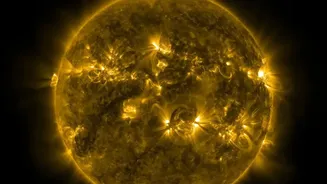
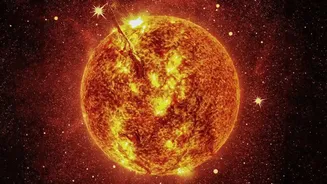
Imagine standing next to a campfire and feeling colder the closer you get. It makes no sense, but that’s the baffling situation scientists face with the sun. The visible surface of the sun, called the photosphere, sizzles at about 5,500 degrees Celsius.
Logic dictates that as you move away from this heat source, the temperature should drop. Yet, the sun’s outer atmosphere, the corona, which is visible as a ghostly halo during a total eclipse, registers temperatures of millions of degrees. This mystery, known as the coronal heating problem, has been one of the most vexing questions in astrophysics for over 75 years. To maintain such extreme heat, the corona must be receiving a constant, massive injection of energy from below. The question has always been: how does that energy travel up from the surface and get deposited into the atmosphere?
A Highway of Waves and Flares
Scientists have long believed the energy is transported upward by one of two main mechanisms, or a combination of both. One theory involves a constant barrage of tiny explosions called “nanoflares,” which are too small and frequent to be seen individually but collectively could release enormous amounts of heat. The other leading theory proposes that energy is carried by waves traveling along the sun's magnetic field lines, which act like energy highways. These aren't waves in water, but waves in plasma—the superheated, electrically charged gas that makes up the sun. These plasma waves, known as magnetohydrodynamic (MHD) waves, could shake the magnetic field lines, carrying energy up into the corona where it then dissipates as heat. While waves have been observed in the corona for years, a key challenge has been proving they carry enough energy to account for the massive temperature discrepancy.
A Breakthrough View of Swirling Plasma
Recent observations from the Daniel K. Inouye Solar Telescope in Hawaii, the largest solar observatory in the world, have provided the most detailed images of the sun's surface ever taken. These images, reported in August 2026, revealed tiny, previously unseen whirlpool-like structures at the boundaries of magnetic regions on the sun’s surface. These swirls are evidence of a phenomenon called the Kelvin-Helmholtz instability, which occurs when two fluids moving at different speeds meet. You can see this effect in clouds or in the waves on a windy lake. On the sun, these instabilities are happening in the plasma, creating vortices that are only about 20 kilometers across but are incredibly energetic. For the first time, scientists could directly observe these wave-like structures forming on the photosphere itself.
How These New Waves Change Everything
The discovery of these Kelvin-Helmholtz vortices is a game-changer because it provides a visible mechanism for how energy can be transferred from the churning surface into the magnetic field. The swirling motion of the plasma twists the magnetic field lines. This twisting action essentially loads the magnetic field with energy, converting kinetic energy from the plasma's movement into stored magnetic energy. This energy can then travel upward along these twisted field lines into the corona. The process is similar to coiling a spring; the energy is stored in the coils and can be released later. Scientists theorize that these waves and instabilities are a crucial part of the energy transport chain. The energy travels up and, through a complex process of turbulence and wave interactions, eventually dissipates, dumping its heat into the corona and solving the heating mystery.
Why This Matters Beyond Just the Sun
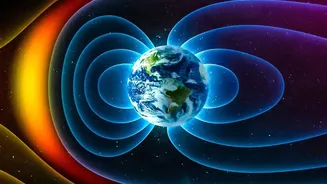
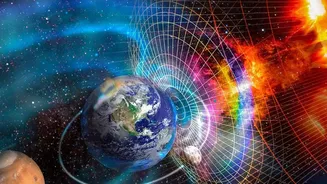
Solving the coronal heating problem isn't just about satisfying scientific curiosity. A deeper understanding of our star's fundamental processes has significant real-world implications. The same mechanisms that heat the corona also drive the solar wind, a constant stream of charged particles flowing from the sun. This solar wind, along with more violent outbursts like solar flares and coronal mass ejections (CMEs), creates what we call space weather. Severe space weather can disrupt satellite communications, damage power grids on Earth, and pose a risk to astronauts. By understanding how energy moves through the sun's atmosphere, scientists can build better models to predict these events. This new insight into plasma waves provides a crucial piece of that puzzle, ultimately helping us protect our technological infrastructure both in space and on the ground.