






Why Breathing Exercises Can Help
When you have asthma, your airways can become inflamed and narrow, making it hard to breathe. This can lead to shallow, rapid breathing using the chest and neck muscles instead of the main breathing muscle, the diaphragm. Over time, this inefficient breathing can worsen
feelings of breathlessness and anxiety. Breathing exercises work to retrain your breathing patterns, strengthen respiratory muscles, improve lung efficiency, and promote relaxation. By learning to breathe more slowly and deeply, you can help manage symptoms, increase your tolerance for physical activity, and improve your overall quality of life.
Technique 1: Diaphragmatic (Belly) Breathing
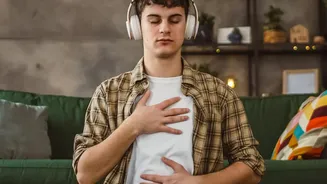
This is a foundational exercise that focuses on engaging your diaphragm, the large muscle located below your lungs. It helps you take deeper, more effective breaths. To start, lie on your back with your knees bent or sit comfortably in a chair. Place one hand on your upper chest and the other on your belly, just below your rib cage. Inhale slowly through your nose for about two seconds, focusing on making your belly rise. The hand on your chest should remain as still as possible. Then, exhale slowly through pursed lips for four seconds, feeling your belly fall. Practice this for 5-10 minutes a day to build muscle memory.
Technique 2: Pursed-Lip Breathing
This simple technique is especially useful when you feel short of breath, as it slows your breathing rate and helps keep airways open longer, releasing trapped air. To practice, relax your neck and shoulders. Breathe in slowly through your nose for a count of two, keeping your mouth closed. Then, pucker or 'purse' your lips as if you were about to blow out a candle. Breathe out slowly and gently through your pursed lips for a count of four. The goal is to make your exhale at least twice as long as your inhale without forcing the air out.
More Advanced Methods: Buteyko and Papworth
The Buteyko method is a system of exercises designed to teach you how to breathe more slowly and gently through your nose, reducing 'over-breathing' or hyperventilation. The core idea is that many people with asthma breathe too deeply, which can trigger symptoms. The Papworth method, developed in the 1960s, combines diaphragmatic breathing with relaxation techniques. It focuses on breathing slowly and steadily from the diaphragm and through the nose, adapting the pattern to different activities. Both methods have been shown in some studies to help reduce symptoms and improve quality of life, but are often best learned with guidance from a trained physiotherapist or practitioner.
Understanding the Limits : What Breathing Practices Can't Do
This is the most critical part of the guide. Breathing exercises are a supplementary therapy, not a replacement for your prescribed asthma medication. They can help manage day - to - day symptoms, reduce anxiety, and strengthen your respiratory system, but they cannot stop the underlying inflammation that causes asthma. Most importantly, these techniques are not meant to be used to control an active asthma attack. During an attack, your airways are constricting, and you need your rescue inhaler or other emergency medication to open them quickly. Trying to manage a severe episode with breathing exercises alone can be dangerous.
How to Get Started Safely
Before starting any new practice, it is crucial to speak with your doctor or asthma specialist. They can help you determine if these exercises are right for you. Begin practicing when you are calm and not feeling breathless. Start with just 5 to 10 minutes a day and be consistent. The goal is for these techniques to become second nature, so you can use them to manage your breathing during physical activity or moments of stress. Pay attention to your body and stop if you feel dizzy or more breathless. The aim is to feel more relaxed and in control, not to cause more strain.