





A Divine Journey of Compassion
At its heart, Rath Yatra is the story of a journey. It commemorates Lord Jagannath's annual visit, along with his elder brother Balabhadra and sister Subhadra, from their sanctum at the Jagannath Temple to the Gundicha Temple, their aunt's abode. This
nine-day sojourn is not just a ritual; it's a powerful symbol of accessibility and divine love. Lord Jagannath, revered as the 'Lord of the Universe', steps out of the temple's confines to grant 'darshan' to everyone, including those who are traditionally barred from entering the main temple. This act embodies the philosophy that God is for all, transcending man-made barriers of caste, creed, and religion. The procession allows devotees to feel a personal connection, to see and be seen by their deity in an open, public space, turning the streets of Puri into a moving temple.
The Chariots: Mobile Temples of Faith
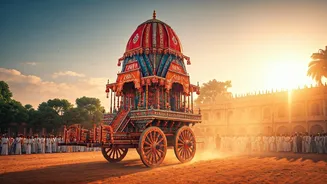
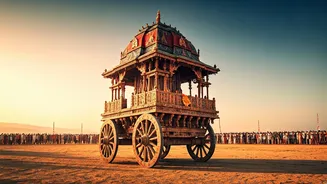
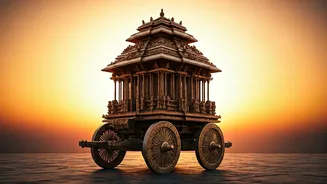
The three chariots are the most iconic symbols of the festival, but they are much more than just vehicles. Each is a masterpiece of sacred architecture and craftsmanship, constructed anew each year from specific types of wood according to ancient traditions. Lord Jagannath's chariot, 'Nandighosha', stands tall at 45 feet with 16 wheels and is adorned with red and yellow fabrics. Lord Balabhadra's chariot, 'Taladhwaja', has 14 wheels and a red and green colour scheme, while Devi Subhadra's 'Darpadalana' is draped in red and black with 12 wheels. These chariots are not merely pulled; they are moved by the collective will and devotion of thousands of people. The act of pulling the ropes is considered an act of great religious merit, a tangible way for devotees to participate in the Lord's journey. They are, in essence, mobile temples carrying the deities through the city, reinforcing the idea that divinity is not static but dynamic and approachable.
A Powerful Symbol of Social Equality
Perhaps the most profound message of Rath Yatra is its powerful stand for social equality. The festival is one of the few occasions where distinctions of caste and social status are completely dissolved. Everyone, from the highest priest to the common devotee, gathers to pull the same ropes. The most potent symbol of this is the 'Chhera Pahanra' ritual. During this ceremony, the Gajapati King of Puri, the foremost royal of the land, sweeps the platforms of the chariots with a golden broom and sprinkles sandalwood water. This act of service, performed by a king, signifies that in the eyes of the Lord, there is no difference between a king and a commoner. It’s a beautiful, humbling tradition that reinforces the message of universal brotherhood and humility, a core tenet of the Jagannath cult.
A Grand Display of Odia Culture
Rath Yatra is also a vibrant celebration of Odia art, music, and literature. The air is filled with the sounds of devotional songs ('bhajans' and 'kirtans'), the rhythmic clang of cymbals ('gini'), and the resounding beat of the traditional Odia percussion instrument, the mardala. Groups of dancers perform the Odissi and Gotipua dances before the chariots, offering their art as a form of worship. The entire festival is an ecosystem of creativity, from the woodcarvers and painters who build and decorate the chariots to the weavers who create the special fabrics, and the priests who chant ancient hymns. It’s a living museum of a rich cultural heritage, passed down through generations, making the festival a vital platform for the preservation and promotion of these traditional arts.