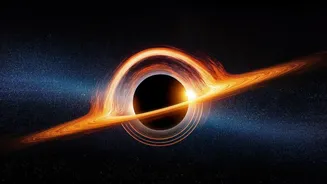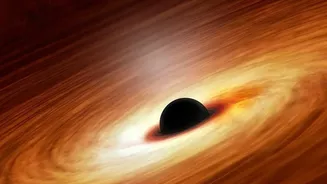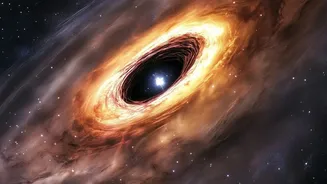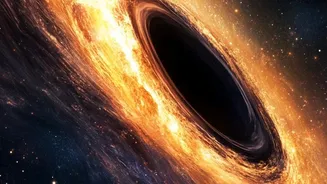





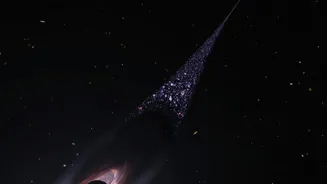
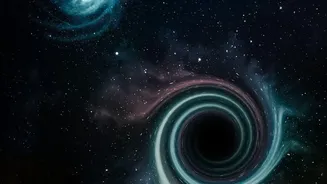
We have seen black holes collide and merge, sending ripples through spacetime. But can the reverse happen? A new theoretical study asks a fascinating question: could a single black hole split into two? Here’s what science has to say about it.
The Cosmic Accounting Problem
In the universe,
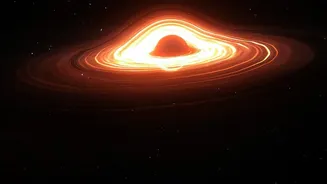
some rules are hard to break. One of them, stemming from the laws of thermodynamics, involves entropy—a measure of disorder. According to physicist Stephen Hawking's area theorem, the total surface area of a black hole's event horizon (its point of no return) cannot decrease. For a single, non-rotating black hole to split into two smaller ones, the total surface area of the two new horizons would be less than the original. This decrease in entropy is 'thermodynamically unfavorable', which is a physicist's way of saying it's forbidden. This principle is why scientists have long assumed that black holes can merge, but never divide.
A Loophole at Maximum Spin
However, a recent theoretical study published in 'Physical Review D' has explored a potential loophole. The researchers calculated that if a black hole is rotating at its maximum possible speed, the physics might change just enough to allow a split. The extreme rotational energy could help overcome the entropy barrier. But there's another catch: for the split to be meaningful, the two new, smaller black holes would have to fly apart fast enough to avoid immediately merging back together. This combination of requirements means that even in theory, the conditions for a black hole split are incredibly narrow and specific, essentially limited to black holes spinning at the very edge of physical possibility.
The Pair-of-Pants Picture
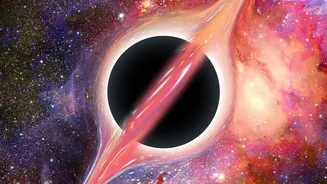
To visualize this bizarre event, scientists use a concept called a 'pair-of-pants topology'. This isn't about celestial clothing, but a way to picture how spacetime itself would behave. The original black hole's event horizon represents the 'waist' of the pants. As it splits, the timeline of the horizon would bifurcate into two 'legs', each representing the separate event horizon of a new, smaller black hole. This strange geometry is a prediction of what a split would look like if it could happen, but it remains a purely theoretical concept. No such event has ever been observed in the cosmos.
The Search for Evidence
So, how would we even look for something like this? While the headline-making study was theoretical, it points toward potential observational clues. Some theories suggest that smaller, primordial black holes might be more prone to splitting than their larger astrophysical cousins. If a split did occur, particularly if one fragment is tiny, it might produce faint signals as it evaporates through Hawking radiation. Telescopes like the Fermi-LAT Gamma-ray Space Telescope could potentially search for these high_energy signatures. But for now, this remains speculative. The headline is accurate: there are no confirmed observations of a black hole dividing. The study simply explores the razor_thin theoretical possibility.
Why 'Null Results' Matter
It might seem anticlimactic to learn that scientists searched for something and found nothing. But in cosmology, a null result is still a result—and a valuable one at that. By confirming we have not yet seen a black hole split, and by outlining the extreme conditions required for it to happen, scientists are placing important constraints on the laws of physics. These studies help refine our understanding of gravity and rule out certain predictions made by theories that go beyond Einstein's General Relativity. The search for splitting black holes, even if it comes up empty, pushes the boundaries of our knowledge and tells us more about the fundamental rules that govern our universe.