



A Phoenix from Stellar Ashes
In the vast expanse of space, astronomers have found compelling evidence for a planet that shouldn’t exist. Orbiting a white dwarf—the dense, collapsed core of a once sun-like star—is a candidate for a 'second-generation' planet. This isn't a hardy survivor
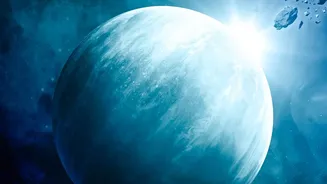
that weathered its star's death throes. Instead, scientists believe this world, potentially a gas giant similar to Jupiter, formed from the very dust and gas ejected when its parent star died. This 'phoenix' planet, found orbiting a white dwarf known as HS 0209+0832, challenges our neat and tidy theories of planetary formation and suggests that even after a star’s life ends, new worlds can rise from the ashes.
The Cosmic Crime Scene
Finding this planet required clever detective work. Astronomers did not see the planet itself but observed its effects on the white dwarf. The key was in the star's atmosphere, which contained unusually high levels of heavy elements like zinc, copper, and especially niobium. These elements are forged late in a star’s life and then cast out into space. Their presence in the white dwarf's atmosphere suggests that material is actively falling onto it. This 'pollution' is the clue. The most likely source is a planet orbiting so closely that the white dwarf's intense radiation is stripping away its atmosphere, which then spirals down onto the star. Data from NASA’s TESS satellite supported this by detecting a regular dip in the star's brightness every 4.4 days, consistent with a large planet completing an orbit.
What is a White Dwarf?
To understand why this is so remarkable, we need to know what a white dwarf is. When a star like our Sun runs out of fuel, it doesn't just switch off. It swells dramatically into a red giant, a phase where it would engulf and destroy its inner planets. After this violent expansion, its outer layers drift away, and the hot, ultra-dense core that remains is called a white dwarf. They are essentially stellar remnants—incredibly hot and about the size of Earth, but with the mass of a star. For a long time, it was assumed that any planetary system would be annihilated during this process. Finding planets around them was rare, and the idea of one forming after the fact was mostly theoretical.
Reading the Indirect Evidence
The claim rests entirely on interpreting this 'indirect evidence'. Direct imaging of such a planet is currently impossible. Instead, scientists build a model that best explains all the observed phenomena. In the case of HS 0209+0832, the combination of a peculiar chemical signature and a periodic dimming signal points strongly towards a second-generation gas giant. Another fascinating method used to study planetary debris around white dwarfs involves their magnetic fields. For a different white dwarf, WD 0816-310, astronomers observed that metals from a shredded asteroid were not evenly spread but were channeled by the star's magnetic field onto one of its poles, creating a 'metal scar'. This shows how magnetic fields can help trace the presence and composition of consumed planetary bodies, another form of indirect evidence.
Why This Discovery Is a Game-Changer
The discovery of a potential second-generation planet fundamentally changes how we think about the lifecycle of planetary systems. It suggests that the end of a star's life isn't the end of planet formation. The raw materials for building new worlds—the heavy elements forged inside the star—can be recycled into a new debris disk from which a second wave of planets can emerge. This opens up fascinating possibilities. Could life, too, get a second chance in a system reborn around a white dwarf? While a gas giant like the one suspected here is not habitable, its existence implies that smaller, rocky planets could also form in these rejuvenated systems, potentially orbiting in a stable habitable zone for billions of years as the white dwarf slowly cools.