






The Digital Compass Dilemma
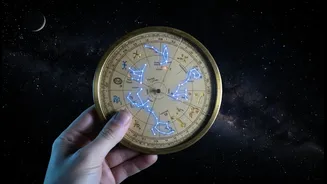
The secret to your stargazing app’s directional sense is a tiny sensor in your phone called a magnetometer, which functions as a digital compass. It measures the Earth's magnetic field to determine which way is north. When it works, it’s brilliant. But
magnetometers are notoriously sensitive and prone to interference. Everyday objects like the magnets in your phone case, metal from a nearby car, or even reinforced concrete can throw off its readings, leading the app to point in the wrong direction. This is why one user might find an app perfectly accurate while another, using the same app on the same phone model, finds it consistently off. It's less often a fault of the app itself and more about the challenging environment we ask these delicate sensors to work in.
Your Analog Anchor in the Sky
This is where a little old-school knowledge becomes a modern-day superpower. Before smartphones, sailors and travellers navigated by the stars for thousands of years. This practice, known as celestial navigation, relies on the predictable and constant position of certain stars. The most famous of these in the Northern Hemisphere is Polaris, the North Star. Because it sits almost directly above the Earth's North Pole, it remains in a fixed position in the sky all night, every night. Learning to find this one star gives you a true, unshakeable sense of direction that no magnetic interference can disrupt. It provides a reliable anchor, allowing you to manually orient your stargazing app and use it with confidence.
Finding North the Natural Way
Finding Polaris is simpler than you might think. First, locate the Big Dipper (part of the constellation Ursa Major), which looks like a large spoon or saucepan. Identify the two stars that form the outer edge of the Dipper's bowl, named Merak and Dubhe. Now, imagine a line extending upwards from these two "pointer stars." Follow that line across the sky, and the first bright star you encounter is Polaris. Polaris is also the last star in the handle of the Little Dipper (Ursa Minor). Once you're facing Polaris, you're facing true north. This ancient technique is not only a satisfying skill to learn but also your key to ensuring your high-tech app is grounded in reality. From there, east is to your right, west is to your left, and south is behind you.
Calibrate, Point, and Conquer
Even with your newfound directional skills, it's good practice to calibrate your phone's compass. Most apps recommend a simple procedure: move your phone in a figure-eight pattern for about 30 seconds. This helps the magnetometer reset and account for local magnetic fields. With your phone calibrated and your own knowledge of north as a backup, you're ready to explore. Popular apps like Star Walk 2, SkyView, and Stellarium Mobile are powerful tools, offering vast catalogues of stars, planets, and nebulae. Many, like Stellarium, are so detailed they contain billions of objects. If an app still seems off, some, like Star Walk 2, allow you to manually align the on-screen map by dragging it to match a bright object you can see, like the Moon or Venus.