





The Frozen Treasure of the Lunar South Pole
For decades, scientists theorised about water on the Moon. India's Chandrayaan-1 mission in 2008 provided the crucial evidence, confirming its presence. This discovery fundamentally changed our relationship with our celestial neighbour. Most of this lunar
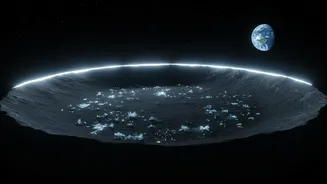
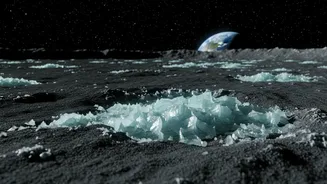
water is believed to be trapped as ice in Permanently Shadowed Regions (PSRs) near the Moon's poles. These are craters and depressions where the sun's rays have not reached for billions of years, creating some of the coldest spots in our solar system. This frozen water is more than just a potential drinking source for future astronauts. It's a game-changer for deep space exploration. By splitting water into its components, hydrogen and oxygen, we can create breathable air and, most importantly, rocket propellant. The Moon could become a refuelling station, making missions to Mars and beyond more feasible and affordable.
ISRO’s Strategy: A Multi-Mission Approach
Tapping into this resource is not a simple task. It requires a methodical strategy, which is exactly what ISRO is developing. Rather than a single mission, ISRO is planning a phased approach to first understand and then utilise lunar water. This involves two key upcoming missions: Chandrayaan-4, a sample return mission, and the Lunar Polar Exploration Mission (LUPEX), a joint project with the Japan Aerospace Exploration Agency (JAXA). A recent study by ISRO scientists has further raised the stakes, suggesting that the amount of subsurface ice in the first few meters is five to eight times greater than the ice found on the surface. This finding makes the development of drilling and extraction technology not just important, but essential for the future of lunar exploration.
Chandrayaan-4: Bringing the Moon to India
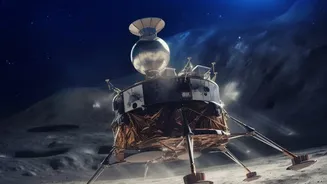
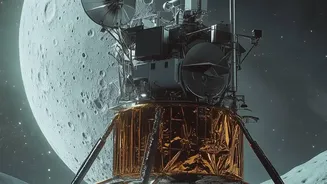
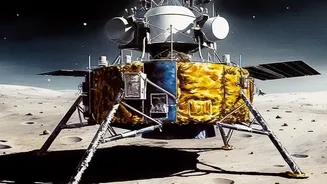
Scheduled for around 2028, Chandrayaan-4 is designed to be the world's first mission to retrieve samples from the Moon's south polar region. The mission plan is incredibly ambitious. A lander will touch down near a promising crater, equipped with a robotic arm and a drill. The robotic arm will scoop up surface soil, while the drill will collect subsurface material, where ice is expected to be more abundant. These samples, totalling around 2-3 kilograms, will be sealed in a container, transferred to an ascender module, and launched back into lunar orbit to eventually return to Earth. By analysing these pristine samples in labs here in India, scientists can get the ultimate 'ground truth' about the composition, concentration, and accessibility of lunar water ice, paving the way for future large-scale operations.
LUPEX: Mapping the Deep Freeze
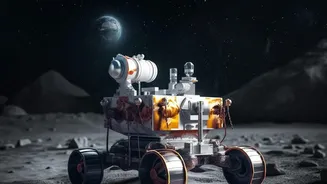
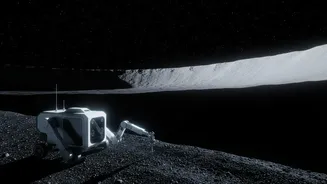
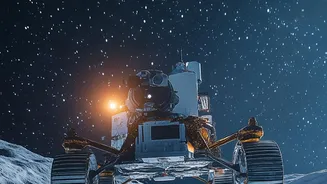
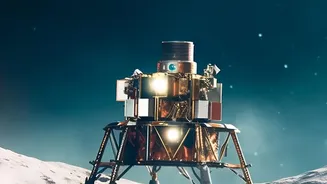
Following Chandrayaan-4, the LUPEX mission (also referred to as Chandrayaan-5) will take the next logical step. In this collaborative effort, ISRO is responsible for the sophisticated lander, while JAXA will provide the powerful H3 launch rocket and a robust 350-kilogram rover. The mission’s goal is to go directly into the dark, frozen craters. The rover will be a mobile laboratory, designed to survive and operate for over three months in one of the harshest environments in the solar system. It will carry a suite of instruments, including a ground-penetrating radar developed by ISRO, to map the underground structure and locate water ice deposits up to several meters deep. It will also feature a drill to analyse the icy soil on-site. This mission will effectively create a detailed map of lunar resources, identifying the most promising locations for future extraction.
The Core Technology for a New Era
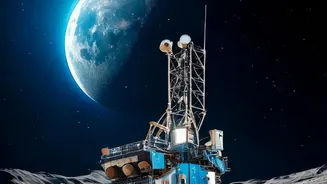
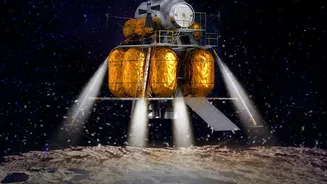
The technologies ISRO is developing for these missions represent the cutting edge of space engineering. The robotic arms must be precise enough to collect samples and transfer them flawlessly. The drilling mechanisms must be robust enough to penetrate the tough lunar regolith in super-cold temperatures. Perhaps most critical is the development of autonomous landing and navigation systems that allow these missions to target specific, high-interest zones near these dark craters. These payloads are not just tools for scientific discovery; they are the foundational hardware for in-situ resource utilisation (ISRU), the principle of living off the land in space. By mastering the ability to find and access water, ISRO is positioning India as a key architect of the emerging lunar economy.