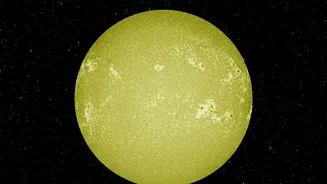









The Sun’s Invisible Threat
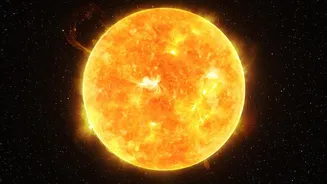
The sun, our source of life and energy, has a volatile side. It occasionally ejects enormous clouds of charged particles and magnetic fields, known as Coronal Mass Ejections (CMEs). While a solar flare’s radiation reaches Earth in about eight minutes,
these plasma clouds travel more slowly, taking anywhere from 12 to 72 hours to arrive. It’s not the flare itself but the CME that poses the most significant physical threat to our infrastructure. When a powerful CME slams into Earth’s magnetic shield, it triggers a geomagnetic storm, an event with the power to disrupt our technologically dependent society. The most famous example, the 1859 Carrington Event, induced currents so strong that telegraph systems sparked and even operated with their batteries disconnected. A similar event today would have catastrophic consequences for our electrified world.
From Space Storm to Ground Current
When a geomagnetic storm rattles our planet's magnetic field, it creates powerful, low-frequency electrical currents that flow through the Earth's crust. These are called geomagnetically induced currents, or GICs. Power grids, with their long transmission lines and grounded equipment, provide an ideal pathway for these rogue currents. GICs flow into the neutral grounding points of high-voltage transformers, the backbone of any electrical grid. These transformers are designed for alternating current (AC), but the quasi-direct current (DC) nature of GICs pushes their magnetic cores into saturation. This leads to a cascade of problems: the transformers can overheat, leading to permanent damage; it creates harmonics that can trip safety relays; and it increases the demand for reactive power, which can destabilize the entire grid and lead to widespread blackouts.
India’s Eyes on the Sun
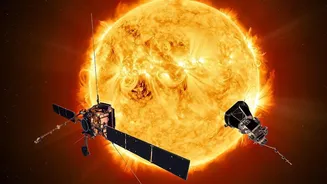
To counter this celestial threat, a global network of solar observatories acts as an early warning system. For India, a key player in this effort is the Aditya-L1 mission. Launched by the Indian Space Research Organisation (ISRO), Aditya-L1 is strategically positioned at Lagrange Point 1 (L1), about 1.5 million kilometres from Earth. This unique vantage point provides an uninterrupted view of the sun, allowing it to monitor solar activity continuously. Equipped with seven scientific payloads, Aditya-L1 studies the sun's atmosphere and magnetic fields, tracking the origins of solar flares and CMEs. Its data helps improve space weather prediction models, providing critical advance warnings of incoming solar storms. This mission marks a significant step for India, moving from being a user of space weather data to a key producer, contributing to a global shield against solar threats.
From Warning to Action
The data from satellites like Aditya-L1, NASA's Solar Dynamics Observatory (SDO), and the SOHO spacecraft is fed to space weather prediction centers around the world, such as NOAA's SWPC in the US and ISRO's own centers in India. These centers issue watches, warnings, and alerts to government agencies and critical infrastructure operators, including power companies. With a lead time of hours to days, grid operators can take protective measures. These actions include postponing non-essential maintenance, adjusting the grid's operating parameters to run more conservatively, and preparing to reduce load or reroute power if necessary. The goal is to brace the system for the impact, minimizing stress on transformers and preventing the kind of cascading failure that could lead to a long-term outage.
Hardening the Grid for the Future
Beyond forecasting, efforts are underway to physically harden the power grid itself. This involves installing devices that can mitigate the effects of GICs. One such technology is a neutral blocking device, which is installed on large power transformers to physically block the flow of damaging induced currents. Other strategies include developing large capacitor banks to absorb sudden energy surges and systems that can quickly drain excess electricity from the grid before it causes damage. Combining advanced forecasting from missions like Aditya-L1 with a more resilient physical infrastructure is our best strategy for protecting modern life from the sun's powerful tantrums. The continuous monitoring and international collaboration ensure that when the next big solar storm heads our way, we won't be caught in the dark.