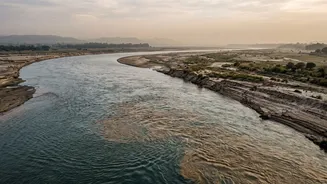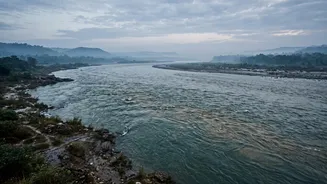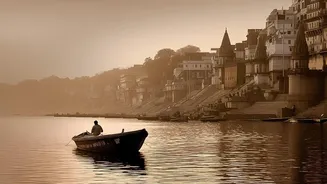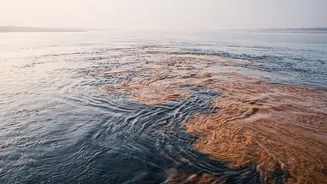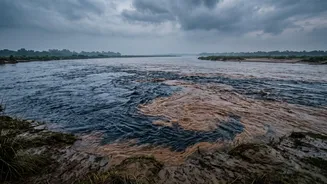





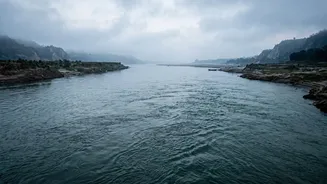
A landmark 1996 treaty on sharing Ganges water, a pillar of India-Bangladesh ties, approaches its 30-year expiry on December 12, 2026. But with climate change, reduced river flows, and new geopolitical realities, can the old pact meet future challenges?
A Historic Handshake Over Troubled Waters
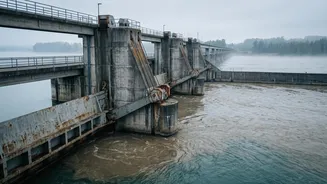
Signed in December 1996, the Ganges Water Treaty was a monumental achievement in South Asian diplomacy. It resolved decades of friction over India's Farakka Barrage, located just upstream from the border. The barrage, designed to divert water to the Hooghly to keep Kolkata Port from silting up, had drastically reduced dry-season flows into Bangladesh, impacting agriculture, fisheries, and public health. The 30-year treaty, signed by then-Prime Ministers H.D. Deve Gowda and Sheikh Hasina, established a water-sharing formula for the critical lean season from January 1 to May 31, bringing a measure of predictability and stability to one of the most vital bilateral relationships in the region.
How the 1996 Treaty Works
The treaty's core is a complex formula based on water availability at Farakka, measured in 10-day periods. If the flow is 70,000 cubic feet per second (cusecs) or less, the two countries share the water on a pro-rata basis. If the flow is between 70,000 and 75,000 cusecs, Bangladesh is allocated 35,000 cusecs, and India receives the remainder. If the flow exceeds 75,000 cusecs, India receives 40,000 cusecs, and Bangladesh gets the rest. A key feature is a series of alternating 10-day periods in March and May, where each country is guaranteed a minimum of 35,000 cusecs, even if total flow is low. However, unlike a previous 1977 agreement, it contains no overarching 'guarantee clause' to protect Bangladesh's share if flows plummet unexpectedly.
New Stresses on an Old Agreement
Three decades on, the ground realities have changed dramatically. The fundamental assumption of a stable water supply is being eroded by climate change. Himalayan glaciers that feed the Ganges are retreating at an alarming rate, threatening long-term dry-season flows. Scientists have documented that recent droughts in the Ganges basin are the worst in centuries, far outside natural climate variability. This has led to dwindling river flows and increased pollutant concentration. At the same time, domestic water demand in both India—particularly in Bihar and West Bengal—and Bangladesh has surged due to population growth, industrialisation, and agricultural needs. These factors are putting immense pressure on an agreement based on historical flow data that may no longer be relevant.
The Geopolitical Crosscurrents
The context for renewal is also shaped by shifting geopolitics. Bangladesh is actively exploring a major Teesta River management project with Chinese funding and engineering, a move that has strategic implications for India given the river's proximity to the sensitive Siliguri Corridor. The political leadership in Dhaka has also changed, with the new government expressing a desire for a revised treaty that includes a 'guarantee clause' similar to the 1977 pact. India has maintained that discussions will happen through the established Joint Rivers Commission (JRC), but the renewal process is unlikely to be automatic. New Delhi has indicated that highlevel political engagement, including a visit by the Bangladeshi Prime Minister, would be necessary to move forward.
The Path to a Future Proof Pact
As the December 2026 deadline approaches, both nations face a critical choice : a simple renewal or a comprehensive renegotiation . Bangladesh ' s government has stated it is preparing to negotiate based on the country ' s long - term water needs . Experts and officials on both sides have floated ideas for a more modern agreement . Suggestions include a shorter treaty duration , moving towards a holistic basin - wide management approach instead of focusing only on water allocation at one point , and incorporating mechanisms to address climate variability , data transparency , and sediment management . The challenge is to replace the rigid arithmetic of the old treaty with a flexible , science - based framework fit for the $^$th century .