



A Sweet Discovery in the Cosmos
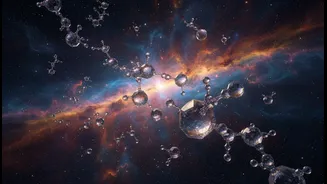
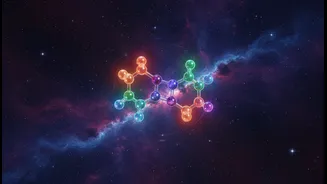
So, what exactly is this molecule that has astronomers so excited? Erythrulose is a four-carbon sugar, which on Earth is found naturally in things like red raspberries. While it might sound simple, its discovery in a giant cloud of gas and dust near the
center of the Milky Way is a major milestone. Scientists have previously found sugars like ribose, a critical component of RNA, preserved inside meteorites that have fallen to Earth. However, the detection of erythrulose is different; it's the first time a true sugar has been found floating freely in the interstellar medium, the raw material from which stars and planets are born. This was achieved by using powerful radio telescopes in Spain to spot the unique spectral 'fingerprint' of the molecule in a cloud named G+0.693-0.027.
The Building Block Hypothesis
The excitement isn't just about finding sugar in space; it's about what this specific sugar represents for the origin of life. Many scientists subscribe to the 'RNA World' hypothesis, a theory suggesting that before DNA existed, life was based on RNA (ribonucleic acid). RNA had the crucial dual ability to both store genetic information and act as an enzyme to catalyse chemical reactions. A key component of RNA is a five-carbon sugar called ribose. The challenge for scientists has been explaining how ribose could have formed on early Earth in large enough quantities. Erythrulose provides a compelling clue. As a four-carbon sugar, it's considered a plausible chemical precursor to ribose. Its presence in interstellar space suggests that the building blocks for life's genetic machinery could have been pre-formed in cosmic clouds.
From Stardust to Biology
This discovery bolsters the theory of panspermia, the idea that life's ingredients were delivered to a young Earth from space. The process is thought to begin in extremely cold (-250C) molecular clouds, where simple molecules on the surface of dust grains react to form more complex ones like erythrulose. Over millions of years, this dust gets incorporated into newly forming asteroids and comets. During periods like the 'Late Heavy Bombardment,' these celestial bodies would have rained down on the early Earth, delivering a cocktail of organic compounds. Scientists estimate that millions of tonnes of erythrulose could have been delivered this way, seeding the primordial soup from which the first life emerged.
What Makes This Finding Significant?
The detection of erythrulose is significant for several reasons. Firstly, at 14 atoms, it is one of the largest and most complex non-cyclic molecules ever identified in the interstellar medium, demonstrating that surprisingly intricate chemistry can occur in space before stars and planets even form. Secondly, it was found to be more abundant than the simpler three-carbon sugars that scientists were also searching for, which challenges some existing models of how molecules grow in complexity in space. According to Dr. Izaskun Jiménez-Serra, who led the research, this discovery opens the door to finding other crucial sugars, like ribose itself, in space and suggests the ingredients for life could be widespread throughout the galaxy.
The Next Frontier in Astrobiology
This find marks a pivotal moment in astrobiology. The focus is shifting from simply asking if life exists elsewhere to a more tangible investigation of its chemical origins. Future research will undoubtedly involve using even more powerful instruments, like the James Webb Space Telescope, to scan other stellar nurseries for erythrulose and even more complex prebiotic molecules. Scientists will also work in labs to replicate the conditions in interstellar clouds to better understand the chemical pathways that lead from simple aldehydes and alcohols to complex sugars. Each new molecule found strengthens the argument that the universe is primed for life, and that the chemistry that sparked life on Earth may not be unique at all.