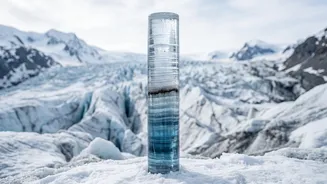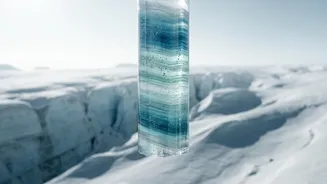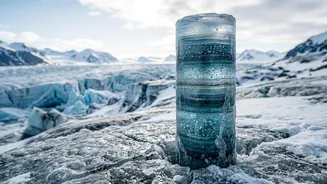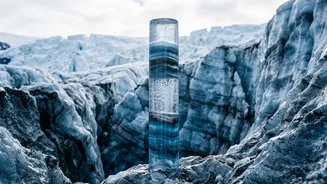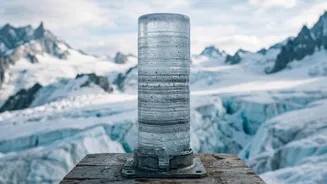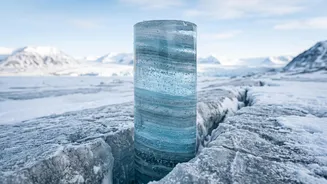




A Library Frozen in Time
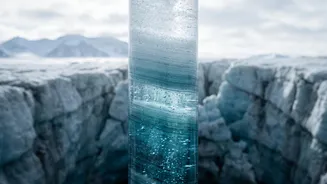
Imagine a place where every year's snowfall is preserved, stacking up layer by layer for hundreds of thousands of years. That’s exactly what happens in the planet’s coldest regions. Each layer of snow traps dust, ash, and tiny bubbles of the atmosphere,
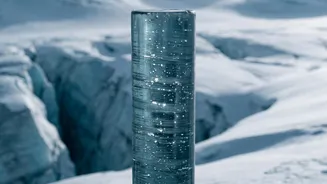
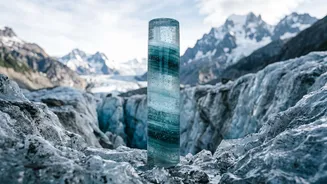
creating a vertical timeline that scientists can read like the rings of a tree. By drilling and extracting long cylinders of ice, called ice cores, they can physically hold and analyze samples of Earth’s past. Some of the deepest cores from Antarctica have provided a continuous climate record stretching back 800,000 years.
The Sun's Cosmic Messengers
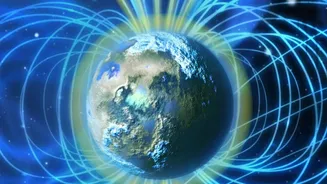
The sun's activity isn't constant; it fluctuates in cycles, from the well-known 11-year sunspot cycle to much longer variations over millennia. A key to tracking this activity lies in something called galactic cosmic rays (GCRs). These are high-energy particles that stream into our solar system from distant supernovae. When the sun is active, its powerful magnetic field acts as a shield, deflecting many of these cosmic rays away from Earth. Conversely, when the sun is in a quieter phase, more of these GCRs can penetrate our atmosphere. This inverse relationship is the crucial first step in how the sun writes its diary in the ice.
An Isotopic Fingerprint
When these high-energy cosmic rays collide with atoms of nitrogen and oxygen in our upper atmosphere, they trigger a nuclear reaction called spallation. This process shatters the atmospheric atoms, creating rare isotopes in the process. One of the most important of these is Beryllium-10 (10Be), a radioactive isotope that is produced almost exclusively by this mechanism. Therefore, the amount of Beryllium-10 in the atmosphere at any given time is a direct proxy for the intensity of cosmic rays hitting Earth. More cosmic rays mean a less active sun, which in turn means more Beryllium-10 is produced.
From the Sky to the Ice
Once created in the stratosphere, these Beryllium-10 atoms don't just stay there. They quickly attach to other tiny particles, or aerosols, floating in the air. Eventually, these particles are washed out of the atmosphere through precipitation—mostly snow in the polar regions. When that snow falls onto an ice sheet, the Beryllium-10 it carries is trapped. Year after year, as new layers of snow accumulate and compress into ice, a long-term record of Beryllium-10 concentration is locked away. A spike in Beryllium-10 in a specific ice layer indicates a period of low solar activity, while a dip signifies a solar maximum.
Reading the Icy Record
To access this record, scientists use specialized drills to extract ice cores, which can be several kilometers long. These cores are carefully transported to laboratories kept at freezing temperatures. Dating the layers is a meticulous process, involving counting annual layers where possible and using chemical markers and models for deeper, more compressed ice. To measure the Beryllium-10, scientists melt sections of the core and use a sophisticated device called an accelerator mass spectrometer. This machine can count the exceedingly rare Beryllium-10 atoms, allowing researchers to plot solar activity over thousands of years with remarkable precision.
What the Past Tells Us
This incredible record has revolutionized our understanding of the sun's influence on Earth. By analyzing Beryllium-10 alongside other markers in the ice, such as isotopes of oxygen that reveal past temperatures, scientists can study how solar activity has correlated with climate shifts. These records have helped confirm long-term orbital cycles, known as Milankovitch cycles, that influence ice ages. They have also identified extreme solar storms that occurred thousands of years ago, providing crucial data for understanding the potential impact of such events today. This information is vital for refining climate models and understanding the natural rhythms that have governed our planet long before human influence became a dominant factor.