
The Astronaut's Ultimate Lifeboat
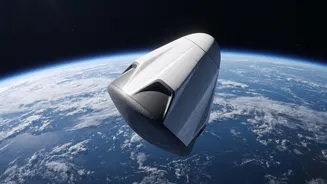
At its core, the Gaganyaan Crew Escape System (CES) is a powerful, rocket-powered safety mechanism. Think of it as a highly sophisticated ejection seat, but instead of just launching a pilot out of a jet, it pulls the entire crew capsule—with the astronauts
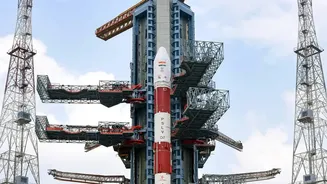
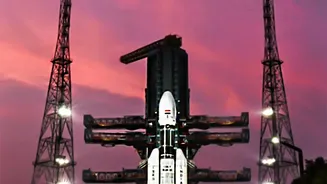
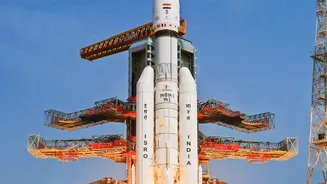
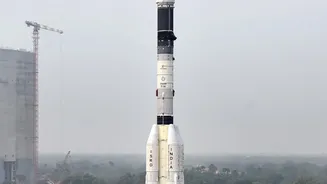
inside—away from a failing launch vehicle. Its sole purpose is to get the crew to a safe distance if anything goes catastrophically wrong on the launchpad or during the initial ascent through the atmosphere. This system is positioned at the very top of the human-rated LVM3 rocket, a tower-like structure that gives Gaganyaan its distinctive pointed shape. It's a 'puller' type system, meaning it literally yanks the crew module upwards and away, a design approach also used in the historic Apollo and Soyuz missions.
An Anatomy of a Split-Second Escape
The escape process is a precisely choreographed sequence triggered in the blink of an eye. The rocket's health is monitored constantly by an autonomous system. If it detects a critical failure—like a loss of thrust or a dangerous deviation from the flight path—it triggers the abort command within milliseconds. Instantly, a set of quick-acting solid propellant motors fires. The main High-Altitude Escape Motors (HEM) and Low-Altitude Escape Motors (LEM) provide a massive burst of thrust, accelerating the crew module with a force up to 10 times that of gravity. Simultaneously, pitch motors fire to steer the capsule on a trajectory away from the exploding or malfunctioning rocket below. The entire system is designed to outrun the disaster unfolding on the launchpad.
From Fiery Ascent to Gentle Splashdown
Once the escape motors have done their job and hurled the crew module to a safe altitude—potentially several kilometres high—the escape tower itself is jettisoned. At this point, the crew module is in a free-fall. The next critical phase is ensuring a safe landing. A sequence of parachutes is deployed automatically to slow the descent. First, smaller drogue parachutes stabilize the capsule, followed by the deployment of large main parachutes. These slow the module to a velocity gentle enough for a soft splashdown in the Bay of Bengal. The module is designed with flotation systems to keep it upright and afloat until recovery teams from the Indian Navy, positioned strategically, can arrive to retrieve the astronauts and the capsule.
Tested Under Extreme Conditions
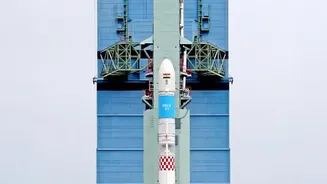
This life-saving technology isn't just theoretical. ISRO has subjected the Crew Escape System to a series of rigorous tests to prove its reliability. A key milestone was the Pad Abort Test (PAT) in 2018, which simulated an emergency right on the launch pad, successfully recovering the test capsule. More recently, the Test Vehicle Abort Mission 1 (TV-D1) in October 2023 demonstrated an even more challenging scenario: an in-flight abort. In this test, a specially designed vehicle was launched to an altitude of about 17 km, traveling at 1.2 times the speed of sound. An abort was deliberately triggered, and the CES performed flawlessly, pulling the crew module clear, deploying its parachutes, and splashing down safely for recovery. These successful tests are critical for validating the system's performance and building confidence ahead of India's first human spaceflight.