




A New Space Race Begins
For decades, a career in India's space sector meant one thing: working for the Indian Space Research Organisation (ISRO). But the landscape is changing dramatically. Following the government's decision in 2020 to open up the sector, India is witnessing
a startup boom. Today, there are around 440 space-tech startups in the country. This shift has been accelerated by the Indian National Space Promotion and Authorisation Centre (IN-SPACe), a single-window agency created to help private companies access ISRO's facilities and technology. This new ecosystem has attracted a surge in private investment, reaching over $618 million by March 2026. The goal is to grow India's share of the global space economy from around 2% to a much larger slice of a market projected to be worth over $44 billion in the next decade. This commercial drive means the industry needs more than just aerospace engineers; it needs people who can manage the massive amounts of data modern space missions generate.
Artificial Intelligence: The Mission's Co-Pilot
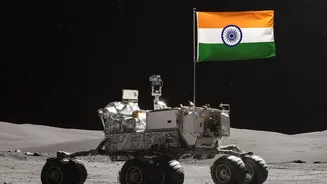
Modern space exploration is as much about data as it is about destinations. This is where Artificial Intelligence (AI) becomes critical. ISRO is already developing AI and machine learning solutions for launch vehicles, spacecraft operations, and big data analytics. The Pragyan rover of the Chandrayaan missions, for instance, used AI for navigation on the lunar surface. For the upcoming Gaganyaan human spaceflight mission, an AI-enabled humanoid named Vyommitra will test the crew module's safety. Private companies are also integrating AI. Bengaluru-based startup Digantara recently unveiled MOSAIC, an AI-powered network to track objects in Low Earth Orbit, bolstering India's space situational awareness. Other startups use AI for onboard satellite data processing, reducing the need to send vast datasets back to Earth. This shift means the demand for professionals skilled in AI is exploding, not just in tech but across all sectors, with job postings for AI skills more than doubling recently.
The Quantum Leap: Securing the Final Frontier
If AI is the brain, quantum technology represents the future nervous system of space exploration. While still an emerging field, its potential is transformative, particularly in two key areas: communication and computation. The Government of India has launched the National Quantum Mission (NQM), a major initiative with a budget of over ₹6,000 crore to make India a leader in quantum tech by 2031. One of the mission's key objectives is to develop satellite-based secure quantum communications over a range of 2,000 kilometres. This technology uses the principles of quantum mechanics to create unhackable communication channels, which are vital for protecting sensitive defence, government, and commercial satellite data. Furthermore, quantum computers promise to solve complex problems that are impossible for even the most powerful supercomputers today. In the space sector, this could mean optimising satellite trajectories, designing revolutionary new materials for spacecraft, and running incredibly complex simulations for climate modelling or deep space missions.
Building the Talent Pipeline for Tomorrow
The message for students and young professionals is clear: the most valuable space careers of the future will be at the intersection of different fields. A degree in aerospace engineering is still a strong foundation, but it is no longer the only path. Companies are actively hiring computer scientists, data analysts, and software engineers with skills in Python, C++, and machine learning. As the National Quantum Mission establishes thematic hubs at institutions like IISc Bengaluru and various IITs, opportunities for specialisation in quantum computing, communication, and sensing will grow. Aspiring space professionals should focus on building a hybrid skill set. This means complementing a core engineering or science degree with expertise in data science, AI model development, and, increasingly, the fundamentals of quantum physics. The future of Indian space exploration will be built not just in workshops and launchpads, but on keyboards and in data centres.