
The Challenge of Distant Worlds
One of the biggest quests in modern astronomy is to find out what the atmospheres of exoplanets—planets orbiting other stars—are made of. The ultimate prize is finding a world with the right ingredients for life, and a key ingredient is water. Telescopes
like the James Webb Space Telescope (JWST) can analyse the light from a distant star as it filters through an exoplanet's atmosphere. This technique, called transit spectroscopy, allows scientists to detect the chemical fingerprints of molecules like water vapour, methane, and carbon dioxide. However, this method has its limits. Many planets, especially those smaller and cooler than the 'hot Jupiters' often studied, are shrouded in thick clouds that block starlight, making it impossible to see what lies beneath. This leaves astronomers with frustratingly incomplete data, hindering the search for potentially habitable worlds.
Our Solar System's Gas Giants as a Laboratory
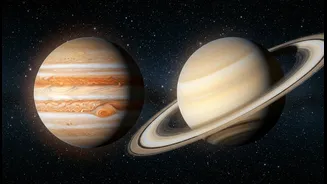
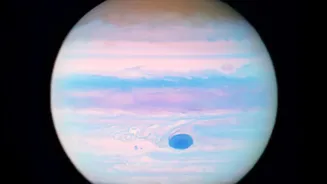
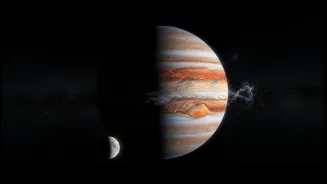
To solve this cosmic puzzle, scientists are turning their gaze inward, toward our own gas giants, Jupiter and Saturn. These planets are natural laboratories for understanding deep, complex atmospheres. Though much colder than the hot exoplanets they are often compared to, the underlying physics of their atmospheric layers, cloud formation, and chemical composition provide a vital blueprint. By studying the composition of Jupiter and Saturn, where we can send probes for direct measurements, scientists can build more accurate models of what happens inside a giant planet's atmosphere. These models help them understand how elements are mixed and which chemical signatures might be visible even above thick cloud layers. For example, because Jupiter is so cold, water condenses deep within its atmosphere, making it hard to measure from afar. Understanding these processes helps scientists better interpret the faint signals they get from distant worlds.
Water Vapour: A Key Clue
Water is a primary target in this research. While it's a prerequisite for life as we know it, its presence and abundance also tell a story about how a planet formed. On gas giants, water is expected to be a dominant carrier of oxygen, one of the most abundant elements in the universe. By precisely measuring water vapour on our own giants, we can test theories of planetary formation. Recent studies of various exoplanets have found that while water vapour is common, its abundance is often lower than models predict. This suggests our understanding of planet formation might be incomplete. Studying Jupiter and its moons provides a crucial reference point. Missions like NASA's Juno have been trying to quantify the water in Jupiter's atmosphere to solve this very puzzle, though the task is difficult. Evidence of water vapour has also been found in the thin atmospheres of Jupiter's moons Ganymede and, potentially, Europa, showing how water behaves in different environments within the same system.
From Local Data to Alien Skies
The knowledge gained from studying Jupiter and Saturn is directly applied to interpreting data from powerful observatories like the JWST. When JWST detects a faint signature of water on a distant, cloudy exoplanet like WASP-96b, the refined models built from our solar system's giants help scientists make sense of it. They can better estimate the amount of water present, the atmospheric temperature, and even infer the presence of clouds or hazes that were previously undetectable. This synergy is crucial. Without the 'ground truth' from our own cosmic backyard, the data from billions of kilometres away would be much harder to decipher. It's the difference between guessing what a single word means and having a dictionary to understand the entire sentence. Studying our gas giants provides that dictionary, allowing astronomers to read the stories being told in alien skies with far greater confidence.