



A New Policy Opens the Floodgates
The transformation of India's space industry began in earnest with landmark government reforms, culminating in the Indian Space Policy 2023. This policy was designed to transition ISRO from a manufacturer and operator into a research and development-focused
agency, similar to NASA. It opened the doors for Non-Governmental Entities (NGEs) to undertake end-to-end space activities, including building rockets and satellites, owning ground stations, and commercialising space-based data. To oversee this new era, the government established the Indian National Space Promotion and Authorisation Centre (IN-SPACe) as a single-window agency. IN-SPACe's role is to authorise, promote, and supervise private space activities, facilitate access to ISRO's extensive infrastructure, and create a predictable regulatory environment for investment. This policy shift has catalyzed a boom in entrepreneurship, with the number of Indian space startups growing from a handful to over 400 by 2026.
The Rocket Builders: Reaching for Orbit
At the forefront of this private-sector charge are the launch vehicle startups. Hyderabad-based Skyroot Aerospace, founded by former ISRO scientists, made history in July 2026 by successfully launching its Vikram-1 rocket into orbit. This achievement made India only the third country, after the US and China, with a private company capable of orbital launches. The mission, named 'Aagaman', demonstrated the viability of privately developed rockets in India. Another key player, Agnikul Cosmos, is pioneering a different approach with its Agnibaan rocket, which features the world's first single-piece, 3D-printed semi-cryogenic engine. This innovation drastically reduces manufacturing time and complexity. After a successful suborbital test flight in May 2024, Agnikul is targeting its first orbital launch by the end of 2026 and is even exploring rocket reusability.
Beyond Launch: Satellites and Data
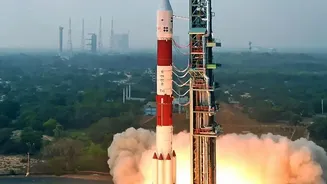
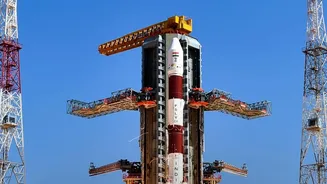
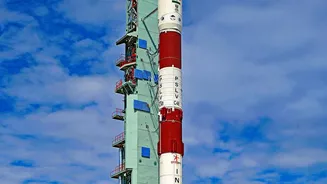
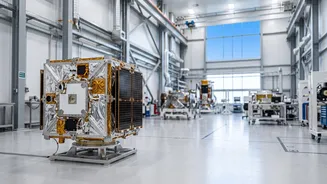
The ecosystem's expansion is not limited to rockets. A growing number of companies are focusing on building satellites and leveraging the data they collect. Pixxel has garnered international attention for its constellation of hyperspectral imaging satellites. These satellites can see the Earth in hundreds of spectral bands, providing incredibly detailed data for agriculture, environmental monitoring, and urban planning. Having launched the first phase of its 'Firefly' constellation, Pixxel recently secured a massive $100 million funding round to expand its capabilities. Meanwhile, Dhruva Space offers full-stack space engineering solutions, building satellite platforms and deployers for a range of clients. In January 2026, the company successfully launched a coordinated mission on an ISRO PSLV rocket, deploying satellites for university, state, and commercial customers, showcasing its ability to simplify access to orbit.
An Ecosystem of Collaboration and Investment
The new model is not one of competition but of public-private partnership. ISRO is actively handholding the private sector, transferring technology and offering its world-class launch facilities and expertise. This symbiotic relationship allows ISRO to focus on ambitious scientific missions while private players handle more routine and commercial tasks. This collaborative environment has attracted significant investment. India's space-tech sector has seen funding surge, with Skyroot Aerospace becoming the country's first space-tech unicorn in May 2026 with a valuation over $1 billion. To further boost the industry, IN-SPACe helped establish the Antariksh Venture Capital Fund, a dedicated fund to nurture and scale promising space startups. This influx of capital is critical for a sector that demands high upfront investment and long development cycles.
The Path Forward
While the progress is undeniable, the path ahead has challenges. Startups will need to secure sustained funding to scale their operations, navigate evolving regulations, and prove commercial viability. However, the momentum is clear. Projections show India's space economy, valued at around $8.4 billion, could grow to over $40 billion by 2033. By building a comprehensive ecosystem that spans launch vehicles, satellite manufacturing, and data analytics, private companies are not just complementing ISRO's legacy; they are launching India into a new orbit as a globally competitive space power.