
Seeing the Unseeable
Exoplanets, or planets outside our solar system, are incredibly difficult to see directly. They are small, dim, and trillions of kilometres away, often lost in the glare of their host stars. Instead of trying to get a direct picture, scientists use clever
techniques to study the light that interacts with these worlds. The primary method is called transit spectroscopy. When an exoplanet passes in front of its star from our perspective, a tiny fraction of the starlight filters through the planet's atmosphere. By capturing and analysing this light, astronomers can identify the chemical fingerprints of the gases and clouds present.
The Power of Infrared Light
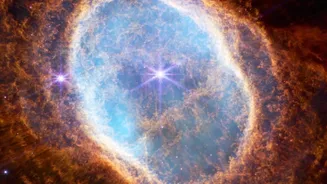
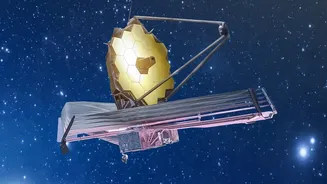
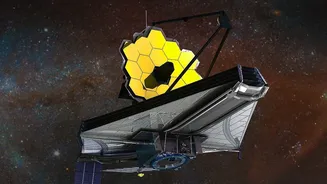
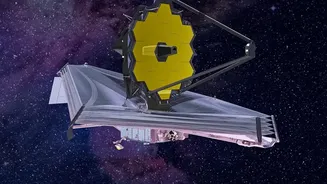
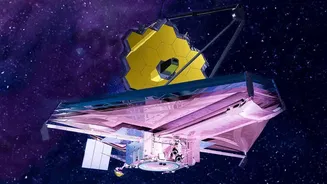
The real breakthrough in this field comes from looking at the universe in infrared light. Visible light, what our eyes can see, is often blocked or scattered by the dense gas and dust clouds that fill space and surround planets. Infrared radiation, which we feel as heat, can penetrate these obscuring layers. This allows telescopes like the James Webb Space Telescope (JWST), which is specifically designed for infrared astronomy, to get a much clearer view. By looking at the infrared spectrum, scientists can detect the heat signature of a planet and identify molecules like water vapour, methane, and carbon dioxide, which are essential clues to understanding a planet's atmosphere and climate.
From Light Signals to Weather Maps
To turn these light signals into a weather map, scientists employ a technique called phase curve spectroscopy. As an exoplanet orbits its star, we see different amounts of its illuminated side, similar to the phases of our Moon. By continuously monitoring the total infrared brightness of the star and planet system throughout the planet's orbit, astronomers can detect subtle changes. For example, the system will appear brightest when the planet’s fully-lit dayside is facing us and dimmest when its dark nightside is in view. This data allows scientists to create a longitudinal map of the planet's temperature.
Decoding the Climate
The temperature map reveals a surprising amount about the planet's weather. Scientists can determine the average temperature on the dayside versus the nightside, which can be dramatically different. On a tidally locked 'hot Jupiter' named WASP-43 b, for example, JWST measured dayside temperatures hot enough to forge iron (around 1,250°C) and a much cooler nightside of 600°C. Furthermore, if the hottest point on the planet is not directly facing the star, it indicates that powerful, supersonic winds are blowing the heat around the planet. This helps model atmospheric circulation patterns, much like meteorologists do for Earth.
Spotting Alien Clouds
Infrared optics are also revolutionary for detecting and understanding clouds on other worlds. On Earth, our clouds are made of water vapour, but on hot exoplanets, they can be composed of vaporised rock and minerals, like silicates. Recent JWST observations of another hot Jupiter, WASP-94A b, revealed a daily cloud cycle. By analysing the atmosphere as the planet rotated, scientists found that its mornings were filled with sand clouds, which then cleared up by the evening. Being able to distinguish between clear and cloudy skies is a massive step forward, as it allows for more accurate measurements of the atmospheric gases that might otherwise be hidden.