


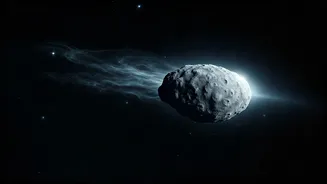



A Visitor From The Void
On July 1, 2025, astronomers using the Asteroid Terrestrial-impact Last Alert System (ATLAS) in Chile spotted a faint object moving through the stars. It was quickly clear this was no ordinary comet. Its trajectory was all wrong. This object, now officially
named 3I/ATLAS, was designated the third interstellar object ('3I') ever detected. Unlike every planet, asteroid, and comet native to our solar system, this visitor originated from the space between the stars, bringing with it secrets of a distant, unknown planetary system. Its name is a nod to its discovery programme, but its significance is cosmic. It is a messenger from another world, offering a rare chance to study the building blocks of a solar system that is not our own.
Not From Around Here
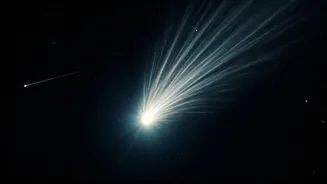
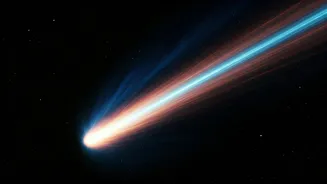
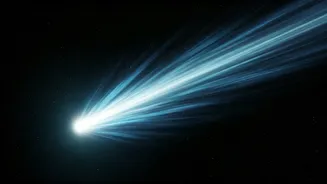
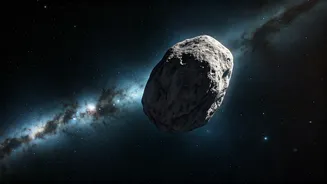
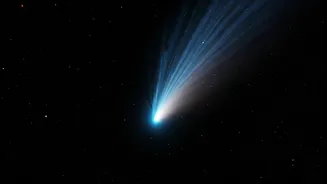
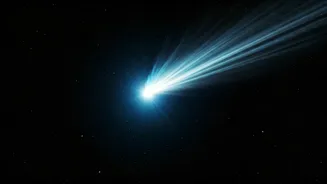
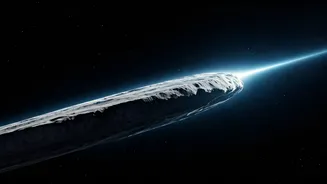
How can scientists be so sure it’s an alien object, in the truest sense of the word? The answer lies in its path. 3I/ATLAS is travelling on an extreme hyperbolic trajectory, moving at such a high velocity—around 220,000 km/h at discovery—that it is not bound by our Sun’s gravity. Think of it like a stone skipping across a pond; it touches down briefly but is moving too fast to be captured. Our solar system's gravity could not have produced this speed. This makes it fundamentally different from the first interstellar visitor, the strange, cigar-shaped 'Oumuamua', and the second, the more conventional comet 2I/Borisov. 3I/ATLAS was confirmed to be an active comet, complete with a fuzzy coma of gas and dust, but one with the highest orbital eccentricity ever recorded for such an object, confirming its foreign origins.
A Global Scientific Effort
The discovery of 3I/ATLAS triggered a worldwide astronomical event. Observatories across the globe, and in space, scrambled to turn their powerful eyes towards the visitor before it disappeared forever. The Hubble Space Telescope, the James Webb Space Telescope (JWST), and even space probes on other missions like ESA's Juice were repurposed to capture data. This global campaign aimed to analyse everything from its size and shape to the chemical composition of the gas and dust boiling off its surface as it neared our Sun, which it did in late October 2025. The goal was simple but profound: to read the chemical fingerprint of another star's building material and compare it to our own.
An Ancient, Icy Messenger
After a year of intense study, the results have been pouring in, and they paint a fascinating picture. On one hand, 3I/ATLAS behaves much like the comets from our own solar system, with a visible coma and tails that react to the Sun's heat in familiar ways. This suggests that the processes that govern comets might be common across different star systems. However, its composition is where things get truly interesting. JWST observations published in 2026 reveal that the comet is made of very old material. It contains a higher ratio of 'heavy water' and low levels of a specific carbon isotope, suggesting it formed in an extremely cold environment, far from its parent star, and long before our own Sun even existed. Some scientists now believe 3I/ATLAS could be one of the oldest, most pristine objects ever observed in our solar system, a true relic from the early universe.
The Heart of the Conversation
The headline-making nature of 3I/ATLAS has inevitably sparked a wide-ranging conversation. For the vast majority of scientists, the excitement is about its unique chemical makeup and ancient origins. It provides a physical sample, however distant, of another corner of the galaxy. However, the mystery surrounding all interstellar objects has also fueled more speculative ideas. Some figures, like Harvard Professor Avi Loeb, have kept the possibility of it being an alien artifact in the public conversation, pointing to supposed anomalies, much as he did with 'Oumuamua. While the scientific consensus firmly identifies 3I/ATLAS as a natural, albeit extraordinary, comet, these debates highlight the profound questions such visitors raise about our place in the cosmos.