




First, Let’s Talk Time
Before we dive into the Venusian puzzle, let's clarify our terms. For any planet, a 'year' is the time it takes to complete one full orbit around its star. For Earth, that’s roughly 365 days. A 'day' is the time it takes for the planet to complete one full rotation
on its own axis. For Earth, that’s about 24 hours. These two clocks—the orbital clock and the rotational clock—are independent. On Earth, they are conveniently aligned, giving us a familiar rhythm of hundreds of days within a single year. But in the vastness of space, this isn't a universal rule. As Venus so dramatically proves, these celestial mechanics can produce some truly mind-bending results.
Venus by the Numbers
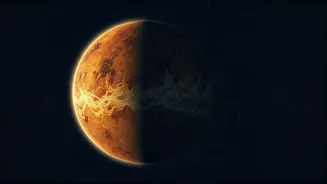
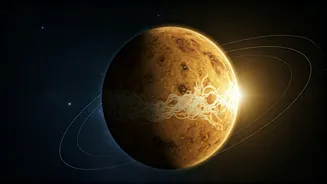
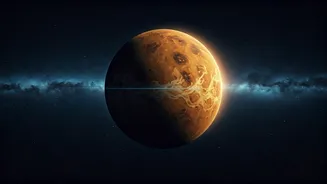
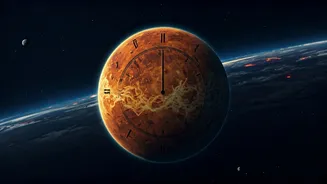
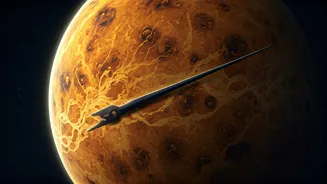
Here's where the maths gets strange. Venus orbits the Sun in approximately 225 Earth days. This is its 'year.' Simple enough. However, Venus rotates on its axis incredibly slowly. One full rotation—what astronomers call a sidereal day—takes about 243 Earth days. Do you see it now? The time it takes for Venus to spin once on its axis (a day) is longer than the time it takes to travel all the way around the Sun (a year). If you were standing on Venus, you'd complete a full trip around the Sun before you even experienced a full rotation of the planet beneath your feet. This makes Venus the only planet in our solar system with a day longer than its year.
The Secret: A Slow, Backward Spin
The oddities don't stop there. The main reason for this temporal weirdness is not just that Venus spins slowly, but that it spins backwards. This is known as retrograde rotation. Nearly every other planet in our solar system, including Earth, spins counter-clockwise on its axis (prograde motion). Venus, however, spins clockwise. This backward spin has a profound effect on the length of its solar day (the time from one sunrise to the next). Because the planet is rotating against the direction of its orbit, the Sun appears to move across the sky much more slowly. The result is a solar day on Venus that lasts about 117 Earth days. So, while a full rotation takes 243 days, you’d only see about two sunrises for every one trip around the Sun. No matter how you measure it, time on Venus is a sluggish, confounding affair.
Why the Bizarre Rotation?
Scientists don't have a single, definitive answer for why Venus is the solar system's oddball spinner, but there are two leading theories. The first involves a catastrophic event deep in its past. Some astronomers believe that a massive asteroid or planet-sized object collided with a young Venus, literally knocking it off-kilter and reversing its spin. The second theory is more gradual. It suggests that the planet’s incredibly thick, heavy atmosphere created powerful tidal forces over billions of years. This dense ocean of air, moving over the planet’s surface, could have acted as a brake, slowing Venus's original, faster rotation and eventually causing it to reverse. It’s possible a combination of both factors is responsible for the planet's unique rotational signature.
A Hellscape Forged by a Long Day
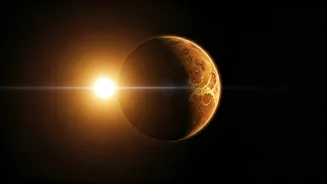
This slow rotation isn’t just a fun trivia fact; it's a key reason why Venus is such an inhospitable world. The long Venusian day means one side of the planet bakes under intense solar radiation for months at a time, while the other side is plunged into an equally long night. This extreme cycle contributes to the planet's runaway greenhouse effect. Surface temperatures on Venus are a scorching 475°C, hot enough to melt lead. The thick atmosphere of carbon dioxide and sulphuric acid clouds traps this heat, making it the hottest planet in the solar system—even hotter than Mercury, which is closer to the Sun. The slow spin also means Venus lacks a protective magnetic field like Earth's, leaving its upper atmosphere exposed to the solar wind, which strips away lighter elements like water.