





A Landmark Discovery on a Lava World
The planet at the center of this discovery is 55 Cancri e, a super-Earth located 41 light-years away. Calling it 'rocky' might conjure images of a world like ours, but 55 Cancri e is anything but hospitable. It is nearly twice the diameter of Earth and
orbits its star so closely that a year lasts less than 18 hours. Its surface is thought to be a scorching, bubbling ocean of magma. For years, scientists have debated whether a planet under such intense heat and radiation could even hold onto an atmosphere. The latest findings from the JWST provide the strongest evidence to date that it can, a major breakthrough in understanding planetary resilience.
How a Telescope Sees an Atmosphere
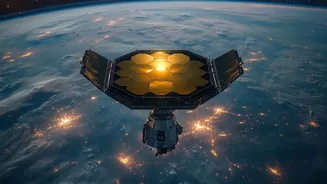
The JWST cannot see 55 Cancri e directly in the way one might photograph Mars. Instead, it uses a technique called transit spectroscopy. As the planet passes in front of its host star from our perspective, a tiny fraction of the starlight filters through the planet's atmosphere. Different molecules in that atmosphere absorb specific wavelengths, or colours, of light. By analyzing the starlight that reaches the telescope and noting which colours are missing, astronomers can deduce the chemical composition of the atmosphere. It’s like identifying a person’s presence in a room by the shadow they cast, but for molecules millions of miles away. In the case of 55 Cancri e, the data suggests the presence of gases like carbon monoxide and carbon dioxide, and hints of water vapour.
A New Kind of Atmosphere
The atmosphere detected around 55 Cancri e is not the original one the planet formed with. That primordial atmosphere would have been blasted away long ago by the intense radiation from its star. Instead, scientists believe this is a 'secondary atmosphere' that is being continuously replenished from within. The intense heat keeps the planet's surface molten, and this vast magma ocean likely releases dissolved gases, which then form the atmosphere. This process of volcanic outgassing is what makes the discovery so significant. It shows that even on the most extreme rocky worlds, geological activity can create and sustain a substantial gaseous envelope.
Why Water on a Hell Planet Matters
Finding signs of water on a world with a surface temperature hot enough to melt rock might seem counterintuitive in the search for life. However, the importance of this discovery is not about habitability, but about possibility. It proves that a key ingredient for life, water, can exist in the atmosphere of a rocky planet outside our solar system. More importantly, it demonstrates that the JWST has the power to detect these subtle chemical fingerprints. This is a crucial proof of concept. If the telescope can characterize the atmosphere of a hellish lava world, it has a very strong chance of being able to do the same for cooler, more Earth-like planets that orbit farther from their stars in the so-called 'habitable zone.'