





Designed to Fly Straight
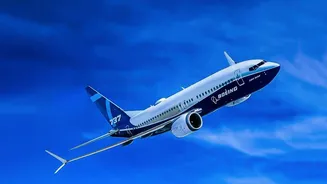
The secret lies in a principle called inherent stability. Commercial aircraft are intentionally designed to be stable, meaning if they're disturbed from their path, they have a natural tendency to return to straight and level flight without pilot input.
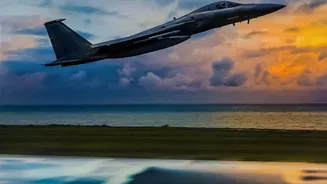
This isn't an accident; it's the result of clever aerodynamic engineering that prioritizes safety and a smooth ride. While fighter jets are often designed to be unstable for greater agility, passenger planes are built to be forgiving and predictable. This reduces pilot workload and ensures the aircraft wants to correct itself during a disturbance. The entire airframe, from the wingtips to the tail, works as a coordinated system to maintain equilibrium.
The Subtle Genius of Wing Shape
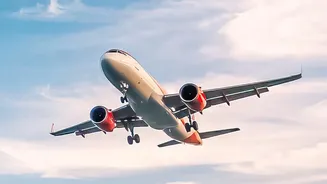
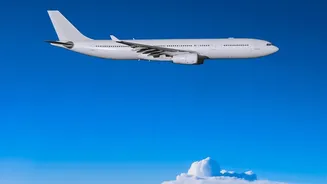
One of the most significant contributors to stability is the upward angle of the wings, known as dihedral. If you look at most airliners head-on, you'll notice the wings aren't perfectly flat but angle up slightly from where they join the fuselage. This simple design feature provides powerful roll stability. If a gust of wind causes one wing to dip, the aircraft begins to slip sideways towards the lower wing. Due to the dihedral angle, the airflow strikes the lower wing at a higher angle, generating more lift than the raised wing. This inequality in lift creates a rolling force that automatically pushes the lower wing back up, leveling the aircraft. It’s a self-correcting system that constantly works to keep the plane balanced.
A Precise Balancing Act
Another crucial aspect is the careful placement of the aircraft's center of gravity (CG) relative to its center of lift. The center of lift is the point where the aerodynamic lifting force of the wings is concentrated. In commercial aircraft, designers intentionally place the CG slightly ahead of the center of lift. This creates a natural tendency for the aircraft's nose to pitch down. While that sounds unstable, it's a key part of the stability equation. To counteract this nose-down tendency, the horizontal stabilizer at the tail is designed to produce a downward force. These two opposing forces—the main wing lifting up and the tail pushing down—create a state of balanced tension, or trim, that keeps the plane flying at a constant attitude.
The All-Important Tail
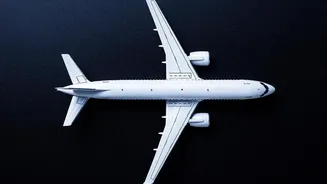
The tail assembly, or empennage, is the unsung hero of stability. It consists of two main parts: the horizontal stabilizer and the vertical stabilizer. As mentioned, the horizontal stabilizer handles pitch stability, preventing the nose from uncontrollably moving up or down. If a gust pitches the nose up, the airflow over the tail changes, automatically adjusting the downward force to push the nose back down to its trimmed position. The vertical stabilizer, or fin, provides directional stability, preventing the nose from swinging side-to-side in a motion called yaw. It works like the feathers on an arrow, keeping the aircraft aligned with the oncoming wind. This is especially critical during a crisis like an engine failure.
Stability During Engine Failure
Modern multi-engine aircraft are designed and certified to fly and land safely with one engine inoperative. When an engine fails, it creates asymmetric thrust, which would naturally cause the plane to turn towards the failed engine. This is where the vertical stabilizer and its movable rudder become vital. The large surface area of the fin allows the pilot to use the rudder to apply a counteracting force, keeping the nose straight and the aircraft under control. The inherent stability designed into the wings and the relationship between the center of gravity and lift also continue to work, helping the aircraft maintain a stable flight path while the pilots manage the situation and prepare for a safe landing.