


For decades, we have understood the universe to be about 13.8 billion years old. But what if that number is wrong? A new theory challenges this fundamental constant of cosmology, proposing our universe might be nearly twice as old.
The Universe's Official Age
The current, widely
accepted age of the universe is based on the Lambda-CDM model, the standard model of cosmology. This model explains many of the universe's large-scale features, including the faint afterglow of the Big Bang, known as the cosmic microwave background (CMB). By measuring the expansion rate of the universe and extrapolating backward, scientists can calculate the moment everything began. Thanks to data from missions like the Planck satellite, this age has been pinpointed with remarkable precision to 13.797 billion years. This figure has been a cornerstone of our understanding of cosmic evolution, from the formation of the first atoms to the clustering of galaxies.
A Wrinkle In Spacetime
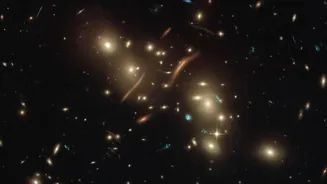
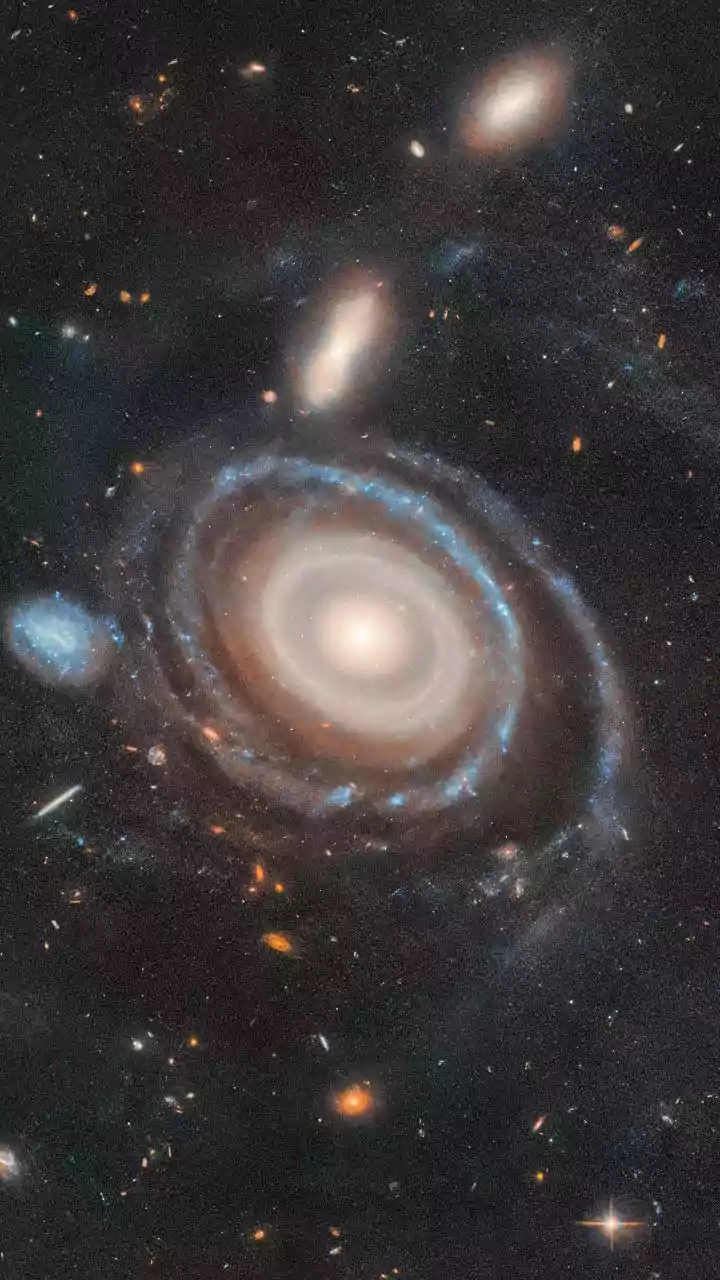
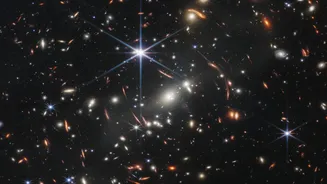
The Lambda-CDM model, for all its success, has faced challenges. One significant puzzle has emerged from observations by the James Webb Space Telescope (JWST). The telescope has spotted galaxies in the very early universe that are surprisingly mature and massive. These 'impossible early galaxies' appear to have developed far more quickly than the standard model would allow, existing just a few hundred million years after the Big Bang but looking as if they've been evolving for billions of years. This discrepancy has prompted some scientists to question whether the universe is truly as young as we think.
An Old Idea Made New
To solve this puzzle, University of Ottawa researcher Rajendra Gupta has proposed a new model that significantly revises the age of the cosmos. His theory combines two ideas: one old and one new. The old idea is the 'tired light' theory, first proposed by Fritz Zwicky in 1929. It suggests that light loses energy as it travels across vast cosmic distances, which would make distant objects appear redder, a phenomenon known as redshift. This was initially dismissed in favour of the expanding universe model, where redshift is caused by galaxies moving away from us. Gupta’s model resurrects a version of tired light and combines it with the idea of 'covarying coupling constants' (CCC). This suggests that the fundamental forces of nature, which govern how particles interact, might change over time.
Doubling the Cosmic Clock
By combining these concepts into a hybrid model called CCC+TL, Gupta calculates that the universe could be 26.7 billion years old, nearly double the standard estimate. This much older universe would easily allow for the formation of the massive, mature galaxies observed by the JWST. In this new framework, a galaxy observed from what we thought was 300 million years after the Big Bang could have actually existed when the universe was already several billion years old, providing ample time for it to develop. The model also suggests that the mysterious effects we attribute to 'dark matter' and 'dark energy' might not be needed, instead being explained by these evolving physical laws.
A Healthy Dose of Scientific Skepticism
While intriguing, Gupta's CCC+TL model is still very much a fringe idea and has not been widely accepted by the cosmological community. The Lambda-CDM model remains extraordinarily successful, explaining a wide array of astronomical observations with high precision. New theories must not only solve a specific problem but also be consistent with all the evidence that supports the existing model. Some analyses have already shown that the CCC+TL model struggles to fit other types of cosmic data, such as measurements of the Hubble parameter from different sources. This is how science progresses: bold new ideas are proposed and then rigorously tested against observation. While it may not rewrite the textbooks tomorrow, this new theory is a powerful reminder that our cosmic story is far from finished, and there are still fundamental questions left to explore.