








Understanding Spacecraft Telemetry
Before diving into the specifics of Psyche, it's helpful to understand what telemetry is. Think of it as a spacecraft's comprehensive health report. In the same way a fitness tracker monitors your heart rate and steps, telemetry tracks hundreds or thousands
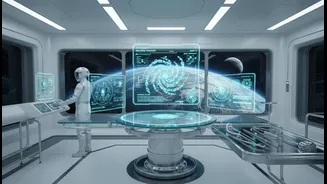
of parameters on a space probe. This includes everything from the temperature of its instruments and the voltage of its power systems to its orientation in space and the status of its software. Traditionally, this data has been encoded into radio waves and sent back to Earth. Scientists on the ground decode this stream of numbers to get a complete picture of the spacecraft's condition, ensuring everything is functioning as expected millions of kilometres from home. This data is fundamental; without it, flying a mission would be like driving a car blindfolded with no dashboard.
Psyche's Laser-Powered Upgrade
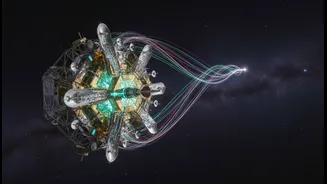
The Psyche mission is not just relying on traditional radio waves. It’s a testbed for a game-changing technology called Deep Space Optical Communications, or DSOC. Instead of radio, DSOC uses an invisible near-infrared laser to transmit information, encoding data into photons—particles of light. The primary advantage of this is bandwidth. Because light waves are much shorter and more tightly packed than radio waves, they can carry significantly more data in a single transmission. The DSOC experiment has demonstrated data rates 10 to 100 times faster than the state-of-the-art radio systems used on other deep space missions. After its launch in October 2023, the system proved its capabilities by streaming a high-definition video of a cat named Taters from 31 million kilometres away at a speed comparable to home broadband internet.
From Faint Photons to Usable Data
Receiving this laser signal is an incredible feat of precision. The process begins with a powerful uplink laser from a facility on Table Mountain, California, which acts as a bright beacon for Psyche's transceiver to lock onto. Once locked, Psyche's own laser transmits its data back toward Earth. By the time this signal reaches us, having travelled hundreds of millions of kilometres, it is incredibly faint. To catch these few photons, scientists use the massive 5.1-metre Hale Telescope at Caltech's Palomar Observatory. The telescope funnels the light into a special detector made of superconducting nanowire, which is sensitive enough to register the arrival of individual photons. These detected photons, representing the ones and zeros of digital information, are then decoded in real-time to reconstruct the original data stream sent from the spacecraft.
Interpreting the Health Report
Once decoded, the telemetry provides two main types of information. The first is spacecraft engineering data—the vital signs of the probe itself. Scientists and engineers meticulously check this data against their expectations. For example, during its flyby of Mars in May 2026, the team used the opportunity to test and calibrate its science instruments, confirming they worked perfectly. They even detected a solar eruption, which verified the magnetometer's sensitivity. If a temperature reading is too high or a voltage is too low, the telemetry provides the first warning, allowing ground control to diagnose the problem and send commands to fix it. This high-resolution data gives a more detailed and faster understanding of the probe's status than was previously possible.
Beyond Vitals: The Scientific Payloads
The second type of information is the science data itself. Psyche carries a suite of instruments, including a multispectral imager, a magnetometer, and a gamma-ray and neutron spectrometer, to study the metal asteroid. The imager will take pictures, the magnetometer will search for an ancient magnetic field, and the spectrometer will determine what elements the asteroid is made of. Even the standard X-band radio system, used for communication and as a backup, contributes to the science by measuring the asteroid's gravity field. All this information, from high-resolution images to elemental composition readings, will be sent back via the DSOC laser and traditional radio systems. Scientists will then interpret this raw data, turning it into maps, magnetic field models, and chemical inventories that will help reveal whether the asteroid Psyche is truly the exposed core of an ancient, shattered planet.