


The Challenge: A Fiery Re-entry
When a spacecraft returns to a planet with an atmosphere, like Earth or Mars, it’s travelling at hypersonic speeds—many times the speed of sound. As it hits the upper atmosphere, the air in front of it can't get out of the way fast enough, compressing
into a superheated layer of plasma. This process, not friction, generates extreme temperatures that can easily incinerate an unprotected probe. The primary job of a heat shield, or aeroshell, is to withstand this thermal onslaught while using the atmosphere's drag as a brake to slow the vehicle down. Getting this right is one of the most critical and challenging phases of any space mission.
The Old Guard: Rigid Heat Shields
For missions from Apollo to the Mars rovers, space agencies have relied on rigid heat shields. These are typically blunt-nosed, dish-shaped structures made of ablative materials that burn away in a controlled manner or heat-resistant tiles that insulate the spacecraft. While effective, they have one significant limitation: size. A rigid heat shield cannot be any wider than the diameter of the rocket fairing—the nose cone that protects the payload during launch. This physical constraint puts a hard cap on how large and heavy a payload can be, especially for planets with thin atmospheres like Mars, where a larger surface area is needed to generate sufficient drag.
The Innovation: A Deployable Solution
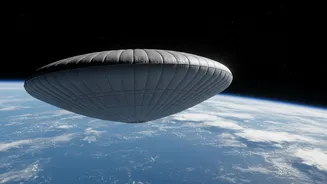
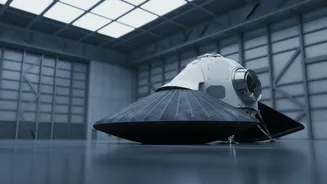
Enter the inflatable heat shield, a technology developed by NASA known as the Hypersonic Inflatable Aerodynamic Decelerator (HIAD). The concept is brilliantly simple in theory: launch a heat shield that is tightly packed, and then inflate it in space just before atmospheric entry. This allows for a decelerator that is much larger than the rocket's diameter, solving the size constraint of rigid shields. By creating a larger surface area, the HIAD acts like a giant brake, beginning the deceleration process higher in the atmosphere where the air is thinner and heating is less intense. This not only improves safety but opens the door to entirely new mission profiles.
How It's Made: More Than a Balloon
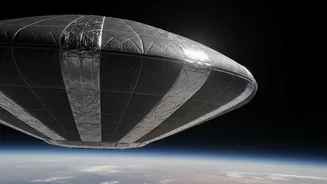
Don't let the word 'inflatable' fool you; this is not a simple balloon. The structure consists of a series of concentric rings woven from synthetic polymers that are, by weight, stronger than steel. These rings are packed for launch and then inflated with a gas like nitrogen to form a strong, rigid cone shape. The exterior is covered by a flexible thermal protection system—a multi-layered blanket made of advanced, heat-resistant ceramic fabrics and insulators capable of withstanding the extreme temperatures of re-entry. This tough, flexible system is a marvel of materials science, designed to be both foldable and incredibly durable.
Proven in Flight
This technology is no longer just a concept. In November 2022, NASA successfully demonstrated a 6-meter HIAD with the Low-Earth Orbit Flight Test of an Inflatable Decelerator (LOFTID) mission. Launched as a secondary payload, the LOFTID aeroshell inflated in orbit and successfully survived a fiery re-entry through Earth's atmosphere at speeds over 18,000 miles per hour, splashing down safely in the Pacific Ocean. The successful test provided crucial data, proving the technology's readiness for future missions and confirming its ability to protect payloads during atmospheric entry.
The Future: Landing Heavier and Exploring Further
The success of inflatable heat shields is a critical step toward more ambitious space exploration. For Mars, this technology is considered essential for landing the heavy payloads—such as habitats, ascent vehicles, and large robotic explorers—required for human missions. Current technology limits Mars landings to about 1.5 metric tons, but HIADs could enable payloads of 20 metric tons or more. This would also allow for landings at higher-altitude sites on Mars that are currently inaccessible but scientifically interesting. Beyond Mars, the technology could be used for missions to Venus and Saturn's moon Titan, or for cost-effectively returning large assets and manufactured goods from Earth orbit.