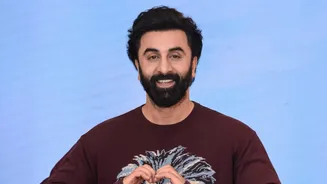








The Unconventional Debut and Early Promise
Ranbir Kapoor’s journey began not with a blockbuster but with Sanjay Leela Bhansali's visually rich but commercially unsuccessful 'Saawariya' (2007). Instead of pivoting to safer, crowd-pleasing roles, his early filmography showed a clear preference for
relatability over glamour. In 'Wake Up Sid' (2009), he played a spoiled, aimless young man forced into adulthood, a character whose growth felt subtle and earned. The same year, 'Rocket Singh: Salesman of the Year' saw him as an idealistic graduate navigating corporate compromises. While neither role fit the hyper-masculine hero mould, they established Kapoor as an actor interested in portraying vulnerability and immaturity, making flawed characters accessible.
The Pivotal Turn Towards Complex Portraits
The real departure from convention came with 'Rockstar' (2011) and 'Barfi!' (2012). In 'Rockstar', he transformed from a college student into a self-destructive, emotionally tormented musician, a role that required him to convey immense ambition and profound heartbreak. The performance was a critical triumph, earning him widespread acclaim. Immediately after, he took on the role of a cheerful, deaf-mute man in 'Barfi!', a character that relied entirely on physical comedy and nuanced expression, drawing comparisons to Charlie Chaplin. These two films, which won him back-to-back Filmfare Awards for Best Actor, cemented his reputation as a fearless performer who prioritized artistic depth over commercial safety.
Embracing the Flawed and Morally Ambiguous
Kapoor’s career is defined by his willingness to play characters who are not just flawed, but often unlikeable. In Imtiaz Ali's 'Tamasha' (2015), he played Ved, a man struggling with a dual identity, torn between a passion for the arts and a monotonous corporate life. Though the film had a mixed reception, his performance was praised for its portrayal of a man unravelling. This trend of embracing difficult characters culminated in 'Animal' (2023), where he played Ranvijay Singh, a violent, morally ambiguous protagonist obsessed with his father. The role was contentious, sparking debates on toxic masculinity, but his commitment to the character's complexity was undeniable and showcased his deliberate choice to explore a darker side of his abilities.
The Actor-Director Collaborations
A significant part of Kapoor's strategy has been his collaboration with visionary directors known for writing complex characters. His work with Imtiaz Ali on 'Rockstar' and 'Tamasha' pushed him into roles that explored existential angst and identity. With Anurag Basu, he created the whimsical worlds of 'Barfi!' and the ambitious but commercially failed musical 'Jagga Jasoos' (2017). Kapoor has acknowledged that directors like these challenge him and force him to unlearn his methods. His partnership with Sandeep Reddy Vanga for 'Animal' was another calculated risk, delving into a character that many mainstream actors would avoid. These collaborations show an actor who is not just a performer but an active participant in creating unconventional narratives.
Balancing Risk with Mainstream Appeal
Despite his reputation for offbeat roles, Kapoor has skillfully balanced his experimental streak with massive commercial successes. Films like 'Ajab Prem Ki Ghazab Kahani' (2009) and 'Yeh Jawaani Hai Deewani' (2013) established him as a romantic lead and a box office draw. However, he uses these mainstream hits not as a career crutch, but as a way to build the commercial clout needed to pursue riskier projects. His success with blockbusters like the biopic 'Sanju' (2018) and the fantasy epic 'Brahmāstra: Part One – Shiva' (2022) has given him the freedom to continue experimenting, proving that an actor doesn't have to choose between being a star and being a storyteller.