





The Target: A Mysterious Ocean World
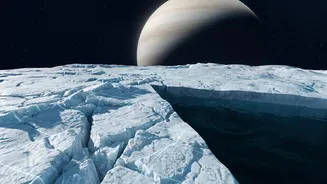
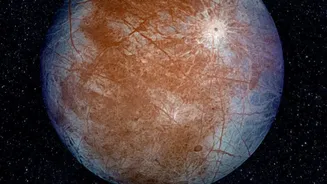
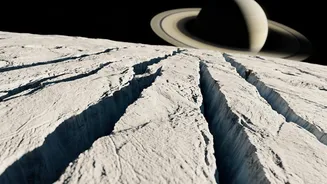
Europa is a fascinating place. Smaller than Earth's moon, its surface is a vast, crisscrossed shell of water ice, believed to be between 15 and 25 kilometres thick. Scientists have strong evidence that beneath this formidable crust lies a colossal saltwater
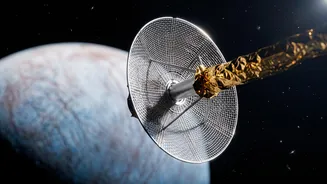
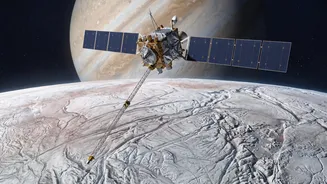
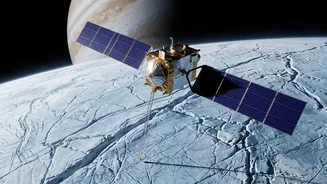
ocean containing more than twice the amount of water as all of Earth's oceans combined. This hidden ocean, potentially in contact with a rocky seafloor, could have the three key ingredients for life as we know it: liquid water, essential chemical building blocks, and a source of energy. However, confirming the ocean's existence and characterising it is the first critical step. That's where the Europa Clipper mission comes in. Launched in October 2024, the spacecraft will arrive in the Jupiter system in 2030 to begin its investigation.
The Tool: Radar for a Cosmic Purpose
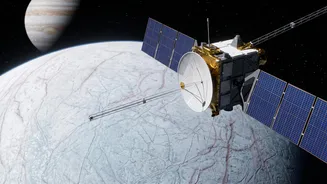
To peer beneath kilometres of solid ice from space, you need a special kind of vision. Europa Clipper is equipped with a suite of nine powerful science instruments, but the star of the show for ocean-hunting is the Radar for Europa Assessment and Sounding: Ocean to Near-surface, or REASON. This instrument is not like the radar used for weather forecasts or air traffic control. It is a sophisticated ice-penetrating radar specifically designed to act like a geological surveyor, sending out radio waves that can pass straight through the ice. The REASON instrument is the only tool on the spacecraft that can look directly into Europa's icy shell, providing the first direct measurements of its internal structure.
How It 'Sees' Through Solid Ice
The principle behind ice-penetrating radar is that certain radio frequencies are mostly transparent to ice. REASON will use two main frequencies: a high-frequency (HF) signal and a very-high-frequency (VHF) signal. As Europa Clipper performs dozens of flybys, its antennas will transmit these radio waves toward Europa's surface. The waves travel down through the ice until they encounter a boundary—a change in material. When this happens, some of the radio wave's energy reflects back to the spacecraft as an echo. By precisely measuring the time it takes for these echoes to return, scientists can calculate the depth of the feature that reflected them. This allows them to build up a 3D map of the ice shell's internal layers.
Distinguishing Water from Ice
Detecting a boundary is one thing, but knowing what that boundary represents is the key. This is where the properties of the echo come into play. Liquid water and solid ice reflect radio waves differently. A large, flat boundary between solid ice and a liquid ocean is expected to produce a very strong, smooth, and bright reflection in the radar data. In contrast, reflections from the rocky seafloor beneath the ocean would be weaker, as the signal has to travel through the water first. By analysing the strength and character of the returning echoes, the REASON science team can distinguish between solid ice, pockets of trapped liquid water, and the vast global ocean they hope to confirm. The radar can even help estimate the ocean's saltiness, as salinity affects how water reflects radio waves.
More Than Just Finding an Ocean
While confirming the subsurface ocean is a primary goal, REASON's capabilities extend further. The data will help scientists measure the overall thickness of the ice shell across the entire moon, a crucial variable for understanding Europa's geology and history. The instrument will also search for smaller, shallower pockets of liquid water trapped within the ice shell itself. These pockets, sometimes called 'perched' lakes, could be vital. They might act as pathways, allowing chemical compounds created by radiation on the surface to mix with water from below. Finding these features would significantly boost the case for Europa's habitability and identify prime targets for a potential future lander mission designed to drill into the ice.