




The Challenge: A Sealed Tin Can
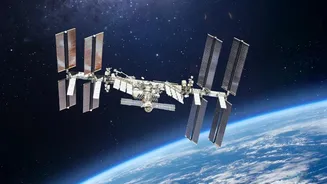
Imagine being sealed in a room. Every breath you take consumes oxygen and releases carbon dioxide. On Earth, this isn't a problem; plants and a vast atmosphere handle it. But on the International Space Station (ISS), the buildup of CO2 would quickly become
toxic for the crew. Early space missions used disposable lithium hydroxide canisters to chemically scrub CO2 from the air, but for a long-term habitat like the ISS, constantly shipping new canisters is impractical and expensive. The only sustainable solution is to recycle. This is the core job of the Environmental Control and Life Support System, or ECLSS.
Step 1: Capturing Carbon Dioxide
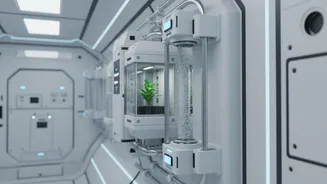
The first step is to remove the CO2 from the cabin air. The primary system on the US segment of the ISS, the Carbon Dioxide Removal Assembly (CDRA), uses beds of tiny, porous crystals called zeolites. Cabin air is passed through these beds. One type of zeolite traps water vapor, and another traps the CO2 molecules, letting the now-purified air continue circulating. Crucially, these zeolite beds are regenerative. By heating them, the trapped CO2 can be vented (currently, mostly into space), and the beds can be used again. The European Space Agency's newer Advanced Closed Loop System (ACLS) uses a similar principle but with unique amine beads to capture CO2.
Step 2: The Magic of the Sabatier Reaction
Just venting CO2 is wasteful because it contains precious oxygen atoms. This is where a century-old chemical process called the Sabatier reaction comes into play. This system takes the captured carbon dioxide and reacts it with hydrogen. The hydrogen is a byproduct from another key piece of hardware: the oxygen generator. Inside the Sabatier reactor, the CO2 and hydrogen pass over a heated catalyst, triggering a reaction that produces two very useful things: pure water (H2O) and methane (CH4). The methane is currently considered a waste product and is vented into space, but the water is priceless.
Step 3: From Water to Breathable Air
The water produced by the Sabatier system—along with water recycled from crewmembers' breath, sweat, and urine—is sent to the Oxygen Generation System (OGS). The OGS uses a process called electrolysis, applying an electrical current from the station's solar panels to split the water molecules (H2O) back into their constituent parts: breathable oxygen (O2) and hydrogen (H2). The oxygen is released into the cabin atmosphere for the crew to breathe. And the hydrogen? It’s sent right back to the Sabatier system to be used again, creating a highly efficient loop.
Closing the Loop: A Near-Perfect System
The headline's 'infinite' respiration is the ultimate goal, but current systems aren't quite there yet. The Sabatier process is brilliant, but it creates methane which is vented, representing a loss of hydrogen from the system. This means the loop isn't perfectly closed. Overall, the ECLSS on the ISS can recycle about 98% of the water on board and about half the carbon dioxide, significantly reducing the amount of water and oxygen that needs to be launched from Earth. Systems like the ESA's ACLS improve this efficiency, but a small amount of resupply is still necessary.
The Future of Breathing on Mars
Perfecting these closed-loop systems is absolutely critical for future long-duration missions to the Moon and Mars, where resupply from Earth will be impossible. Scientists are working on next-generation technologies to close the loop completely, potentially by finding ways to break down the waste methane to recover its hydrogen. Technologies are also being developed that could use resources found on Mars itself, like the carbon dioxide in its atmosphere, to produce oxygen—a concept called in-situ resource utilization (ISRU). The lessons learned from the intricate, life-giving dance of molecules on the ISS are paving the way for humanity's next giant leap.