



The New Lunar Gold Rush
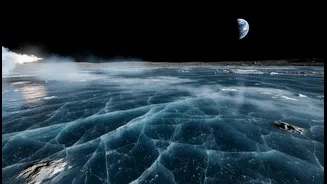
A new space race is on, but this time the prize isn't just footprints and flags; it's water. For decades, the Moon was considered a dry, dead world. But a series of missions confirmed the presence of significant water ice deposits, especially within Permanently
Shadowed Regions (PSRs) at the poles. These are craters so deep or angled that their floors have not seen sunlight in billions of years, creating frigid traps that have collected volatiles, including water. This discovery was a game-changer. Lunar water isn't just a scientific curiosity; it's a critical resource. It can be purified for drinking and growing food, and its components—hydrogen and oxygen—can be split to create breathable air and rocket fuel. This potential for in-situ resource utilization (ISRU) makes the idea of a sustainable lunar base, and a staging point for missions to Mars, economically and logistically feasible for the first time. As a result, agencies like NASA with its Artemis program, along with a growing number of commercial companies, are all setting their sights on these icy polar regions.
What is Planetary Protection?
As humanity ventures farther into the cosmos, it’s governed by a key principle: be a good visitor. This is the core idea behind planetary protection. It isn't about fending off hostile aliens, but about ensuring we don't contaminate other worlds with Earth-based microbes (forward contamination) and, conversely, that we don't bring anything dangerous back home (backward contamination). The internationally agreed-upon guidelines are set by the Committee on Space Research (COSPAR), providing a framework that helps nations comply with the 1967 Outer Space Treaty. This treaty obligates spacefaring nations to avoid the "harmful contamination" of celestial bodies. The rules vary depending on the destination. A mission to an asteroid might have lenient requirements, while a lander headed for Mars, where life might exist, faces incredibly strict sterilization protocols. The Moon was long considered a low-risk body, but the discovery of water ice, a key ingredient for life, changed the conversation and put it squarely in the middle of a complex policy debate.
The Problem with a Dirty Landing
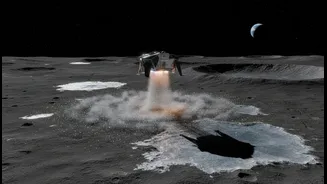
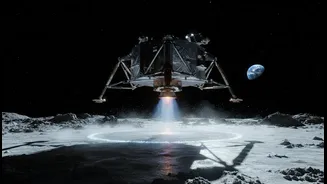
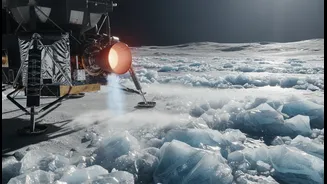
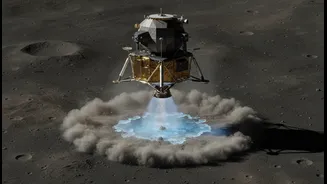
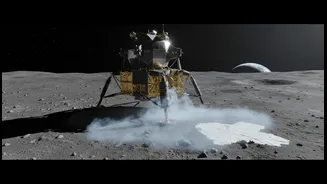
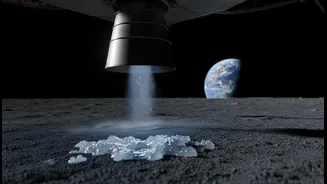
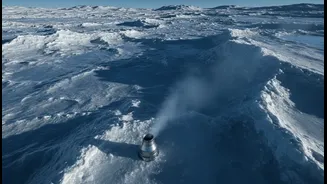
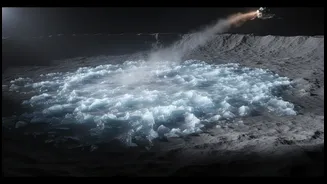
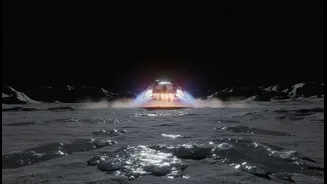
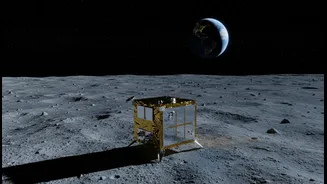
Here's the paradox: to study or harvest the Moon's precious ice, you first have to land a spacecraft nearby. And spacecraft are messy. As a lander fires its engines for a soft touchdown, its exhaust plumes kick up tons of lunar dust and, more importantly, release gases—including water vapor and methane—into the Moon’s extremely thin atmosphere. Because the Moon has virtually no air, these exhaust gases don't just dissipate. They can travel vast distances. Recent computer simulations show that exhaust from a single landing near the south pole can spread globally in mere hours and reach the north pole within a few days. A significant portion of these exhaust chemicals, especially water, eventually settles and freezes in the same ultra-cold polar craters that hold the ancient, pristine ice scientists want to study. This risks permanently contaminating the very scientific record we hope to read—a record that could hold clues about the origin of water in our solar system and perhaps even the building blocks of life on Earth.
Rewriting the Rules for a New Era
The conflict between exploration and preservation has forced space agencies to rethink the old rules. For years, the Moon was mostly treated as a single entity with minimal protection requirements. But the scientific and strategic value of the polar ice has led COSPAR and NASA to adopt a more nuanced approach. The Moon's surface is now being unofficially zoned. Most of the Moon remains a low-priority area, but the polar regions containing ice are now designated as more sensitive, requiring missions to document their organic and volatile inventories. This is a fundamental shift in how we manage our presence on another world. Instead of a blanket policy, decisions are becoming more granular. It forces mission planners to make critical choices about landing sites, trajectories, and even the types of propellant used to minimize contamination. The goal is to create a framework that allows for resource utilization while protecting scientifically priceless locations from being compromised before they can even be studied.
A Delicate Balancing Act
There are no easy answers. The debate pits two valid and powerful interests against each other. On one side, scientists argue that allowing uncontrolled contamination of the Moon's polar ice would be an act of irreversible vandalism, destroying a unique historical archive that has been preserved for billions of years. Once terrestrial water and chemicals mix with the native ice, it will become nearly impossible to distinguish between what is originally lunar and what we brought with us. On the other side, proponents of exploration and settlement argue that overly strict protection protocols could make missions prohibitively expensive or complex, strangling the development of a lunar economy before it even begins. Finding a middle ground is the central challenge. It may involve establishing exclusion zones around the most pristine ice deposits, developing cleaner landing technologies, or deploying monitoring equipment to track the spread of contaminants with every mission.