





A Rotorcraft for an Alien Moon
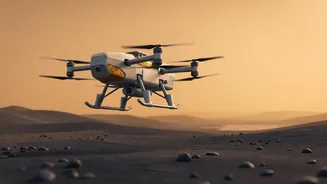
At its heart, the Dragonfly mission is built around a revolutionary vehicle: a dual-quadcopter, essentially a drone with eight rotors. This nuclear-powered rotorcraft is designed to do what no machine has ever done before—perform powered, controlled flight
on another moon. Titan is the perfect place for such a feat. Its atmosphere is four times denser than Earth's, but its gravity is only about one-seventh as strong. This combination means that flying is significantly easier than on Earth or Mars, allowing a heavy, instrument-laden craft to take off, travel significant distances, and land again. Instead of being powered by the sun, which is too faint at Saturn's distance, Dragonfly will rely on a Multi-Mission Radioisotope Thermoelectric Generator (MMRTG), the same kind of nuclear power source that has kept Mars rovers like Curiosity and Perseverance operating for years.
Why Titan is an Irresistible Target
Saturn's largest moon, Titan, is one of the most compelling destinations in our solar system. It is the only moon with a thick atmosphere, and in many ways, it resembles a frozen, primitive Earth. Titan has weather, clouds, rivers, lakes, and seas, but instead of water, they are composed of liquid methane and ethane. Beneath its icy crust lies a vast ocean of liquid water. Most importantly for scientists, Titan's surface is covered in a complex soup of organic chemicals. Its nitrogen and methane-rich atmosphere is constantly creating complex organic molecules that rain down onto the surface. This makes it a unique natural laboratory for studying prebiotic chemistry—the chemical steps that may have occurred on Earth that led to the origin of life.
A New Paradigm: Beyond Roving and Orbiting
Planetary exploration has historically been a choice between two models. Orbiters, like the Cassini spacecraft that studied Saturn, provide a fantastic global overview but cannot analyze materials on the ground. Landers and rovers, like those on Mars, can perform detailed surface science but are severely limited in their mobility. Mars rovers, for example, travel incredibly slowly, covering only short distances over many years. Dragonfly shatters this limitation. By being able to fly, it combines the best of both worlds. It can travel tens of kilometers in a single flight, vastly farther than a rover could in its entire mission. This allows it to act as a mobile laboratory, flying from one diverse geological site to another—from sand dunes to the floor of an impact crater—to collect and analyze samples. This ability to quickly relocate and study different environments represents a fundamental shift in exploration strategy.
The Search for Life's Building Blocks
Dragonfly is not explicitly looking for life itself. Instead, its primary mission is to investigate Titan's chemistry to understand the processes that lead to the formation of biologically relevant compounds. It will carry a sophisticated suite of instruments, including a mass spectrometer to identify the chemical makeup of samples and a drill to collect materials from below the surface. By analyzing different locations, such as areas where liquid water from an impact melt may have mixed with the surface organics, scientists hope to find clues about how life might arise. Titan offers a chance to see the kind of prebiotic chemistry that happened on early Earth, a record that has been long erased on our own planet by geology and biology. The mission will help characterize Titan's habitability and explore one of the biggest questions in science: are the ingredients for life common in the universe?