




Chasing Pestilence with Sticks
The name 'Behdienkhlam' literally translates from the Pnar language to 'chasing away the demon of cholera' or 'driving away pestilence with sticks'. This powerful name hints at its origins as a ritualistic cleansing to protect the community from diseases,
a prayer for public health that predates modern medicine. Celebrated annually in July after the sowing season, the festival is the most significant cultural event for the Pnar people, who follow the indigenous Niamtre faith. It is a profound invocation for divine protection, seeking blessings for a bountiful harvest and the well-being of the community. The main celebrations unfold in the town of Jowai, drawing participants and spectators from across the region.
A Journey of Sacred Wood
The festival's rituals begin long before the main event. One of the initial rites involves the felling of towering, sacred trees from a protected forest. These massive logs, known as 'khnongs', are then carried into the town by groups of men in a powerful display of community effort. Another key element is the creation of 'rots'—tall, intricate tower-like structures made from bamboo and decorated with colourful paper. Each locality (dong) vies to create the most impressive 'rot'. These structures often carry messages on social or political issues, blending ancient tradition with contemporary commentary. The procession of these rots through the rain-drenched streets, accompanied by the hypnotic beat of drums and pipes, is a central part of the festival's visual splendour.
The Rhythm of Ritual
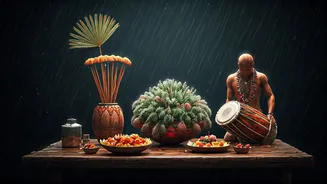
Over four days, a series of rituals unfolds. The Daloi, or traditional chief, performs key religious rites, making offerings to the ancestors. Young men go from house to house, beating the roofs with bamboo poles in a symbolic act to drive away sickness and evil spirits. This act of communal purification is one of the festival’s most defining moments. While men dominate the public rituals, including the energetic dancing, women play a crucial role behind the scenes. They are responsible for preparing ceremonial food and making offerings to the spirits of their forefathers, ensuring the ancestral covenant is upheld. The festival also serves as a homecoming, with many who have moved away returning to their ancestral lands to participate.
A Grand, Muddy Finale
The festival culminates on the final day at a sacred pool in Jowai known as Aitnar. Here, amidst a fervent crowd, the 'rots' and 'khnongs' are ceremonially immersed in the muddy water. It is believed that the presence of rain during this finale is a good omen. Following the immersion, a unique game called 'datlawakor' is played. Resembling a form of pushball with a wooden ball, two teams compete to push the ball to their opponent's side of the field. Tradition holds that the winning side will be blessed with a more bountiful harvest in the coming year, linking the game directly to the community's agricultural prosperity.