







The Challenge of Measuring a Planet
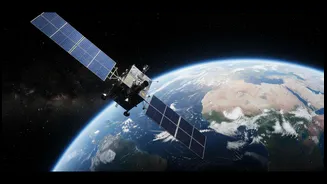
For decades, a fleet of satellites has been our eyes on the Earth, constantly monitoring everything from sea surface temperatures to the brightness of clouds. This data is the bedrock of our climate records. However, a significant challenge exists: ensuring
all these different instruments, launched at different times with different technologies, are speaking the same language. Over time, the harsh environment of space can cause a satellite's sensors to degrade or 'drift', introducing tiny errors. These subtle shifts, though small, can create uncertainty in long-term climate trends, making it harder to distinguish a genuine climate signal from instrumental noise. This is the problem of 'uncalibrated certainty'—confidence in data that may have hidden inaccuracies.
Enter CLARREO Pathfinder
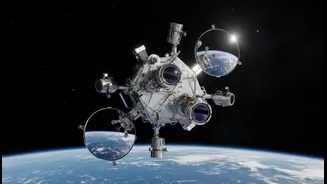
The Climate Absolute Radiance and Refractivity Observatory (CLARREO) Pathfinder is NASA's answer to this problem. Set to be hosted on the International Space Station, it's not just another weather satellite. Instead of simply collecting more data, its primary mission is to serve as a master reference point in orbit. Think of it less as another thermometer and more as a perfectly calibrated tuning fork in space. Its goal is to demonstrate the technology and techniques that can make measurements of reflected sunlight from Earth five to ten times more accurate than existing sensors. This mission is a 'pathfinder', proving the concept for a potential future fleet of climate-calibrating satellites.
A Master Reference in Orbit
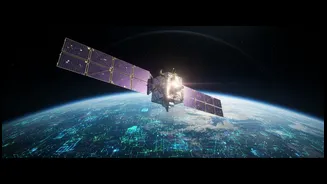
So how does it work? The CLARREO Pathfinder will achieve unprecedented accuracy by regularly calibrating itself. It will measure highly stable and well-known sources, like the Sun and the Moon, to ensure its own readings are consistently true and traceable to international standards. Once its own accuracy is established, it will perform a crucial task: inter-calibration. As it orbits the Earth, its path will cross those of other Earth-observing satellites, like the CERES and VIIRS instruments. By looking at the same spot on Earth at nearly the same time, CLARREO Pathfinder can provide a benchmark measurement, allowing scientists to cross-check and correct the data from the other satellites. This effectively 'tunes' the entire network of climate sensors to a single, highly accurate standard.
From Better Data to Bolder Decisions
The implications of this are profound. With more accurate and reliable data, the uncertainty in our climate records shrinks. When data from different satellites is harmonized, it becomes much easier to detect the subtle, long-term trends of climate change. This increased confidence allows scientists to test and refine climate models with greater precision. For policymakers and the public in countries like India, which are highly vulnerable to climate impacts, this isn't just an academic exercise. More reliable climate models lead to more trustworthy predictions about everything from monsoon patterns and agricultural yields to sea-level rise, enabling more effective planning and adaptation strategies.
The Path to Higher Certainty
The CLARREO Pathfinder mission, which began in 2016, represents a fundamental shift in climate monitoring. It acknowledges that the challenge is no longer just about proving that the climate is changing, but about understanding the rate and regional impacts with the highest possible confidence. By establishing a new benchmark for accuracy, the mission promises to remove ambiguity from our climate records. The data gathered during its one-year operational phase, followed by a year of analysis, will be made publicly available, providing a vital resource for the global scientific community. If successful, this pathfinder will have paved the way for a new era of climate science, one built on a foundation of unshakeable, well-calibrated certainty.