



The Challenge of Flying Low
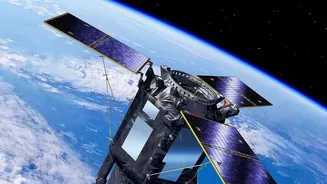
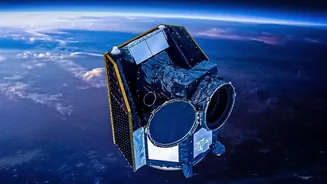
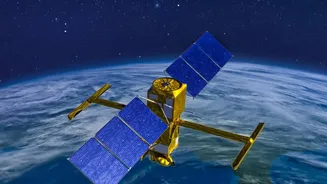
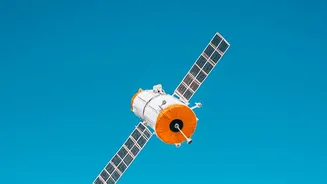
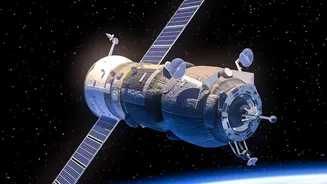
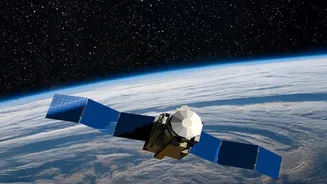
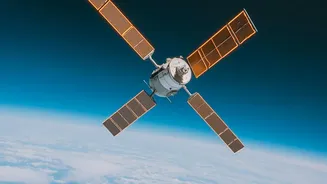
For satellites, getting closer to Earth has huge advantages. Operating in Very Low Earth Orbit (VLEO), an altitude generally below 450 kilometres, means earth observation satellites can capture much higher-resolution images and communication satellites can offer
lower-latency signals. The problem is that VLEO isn't true space; a thin atmosphere still exists there. While incredibly sparse, the residual air molecules create constant drag on a satellite moving at over 7 kilometres per second, causing its orbit to decay rapidly. To stay aloft, satellites must constantly fire thrusters to counteract this drag. This requires carrying large amounts of propellant, which limits the satellite's lifespan and increases its launch weight and cost. The European Space Agency's GOCE satellite, for instance, operated below 260 km but its mission ended when its 40 kg of xenon propellant ran out.
A Revolutionary Engine That Breathes
Air-Breathing Electric Propulsion (ABEP) offers a radical new approach. Instead of carrying a finite supply of propellant, an ABEP system ingests the surrounding atmospheric particles and uses them as fuel. The very same air molecules that create drag are collected, energized, and expelled to produce thrust. This breakthrough could allow satellites to operate in VLEO for years on end, limited only by the lifespan of their components rather than their fuel tank. The concept has been explored for decades, but recent advancements in electric propulsion and materials have brought it from theory to tangible reality, with multiple agencies and companies now developing and testing prototypes. The European Space Agency (ESA) successfully conducted a world-first test firing of such a thruster in 2018, proving the concept was viable.
How to Turn Air Into Thrust
The process is elegant in its core concept. An ABEP system consists of two main parts: a special intake and an electric thruster. The intake is designed to passively collect and compress the scarce atmospheric molecules without simply having them bounce off. Once collected, these gases—mostly atomic oxygen and nitrogen at these altitudes—are channeled into the thruster. There, they are ionized, meaning they are given an electric charge. Using power generated by the satellite's solar arrays, an electromagnetic field then accelerates these newly created ions and ejects them at high velocity. This expulsion of ions generates a small but continuous thrust that precisely counteracts the atmospheric drag, allowing the satellite to maintain its orbit indefinitely.
Unlocking New Commercial and Scientific Frontiers
The ability to sustain orbits in VLEO opens up a host of new possibilities. For commercial operators, it means providing sharper satellite imagery for agriculture and urban planning, and faster internet service with less delay. For science, it allows for more detailed monitoring of weather patterns and climate change. Militaries are also interested for surveillance and reconnaissance advantages. Furthermore, the VLEO region is often described as 'self-cleaning'; the inherent atmospheric drag means that when a satellite's mission ends, it will naturally de-orbit and burn up within weeks or months, mitigating the growing problem of long-term space debris. This technology could even be applied to other planets with atmospheres, like using the carbon dioxide on Mars to propel future exploration missions.
The Road Ahead for ABEP
Despite its immense promise, ABEP technology is still in its early stages and faces significant hurdles. Designing an intake that is efficient at collecting particles without creating too much drag is a major engineering challenge. The VLEO environment is also harsh, with highly corrosive atomic oxygen that can degrade spacecraft materials. However, progress is rapid. The ESA, along with EU-funded projects like BREATHE and AETHER, are advancing the technology. In the private sector, companies like the US-based Phase Four, Viridian, and CU Aerospace have secured contracts from agencies like DARPA to develop their own systems. Even in India, a startup called Orbitt Space is developing its own ABEP engine. As these systems mature from ground tests to on-orbit demonstrations, they are poised to revolutionize the economics and capabilities of satellite operations.