








The World's Largest Telescope
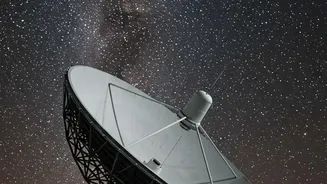
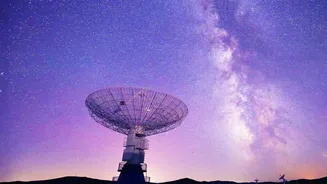
The Square Kilometre Array isn't just one telescope, but a vast network of thousands of antennas spread across two continents. The SKA-Mid array, featuring hundreds of dish antennas, is located in South Africa, while the SKA-Low array, with over 130,000
'Christmas tree-like' antennas, is in Western Australia. Together, they act as a single, gigantic eye on the universe, with a combined collecting area that will eventually approach one square kilometre. This immense scale makes the SKA 50 times more sensitive than any previous radio instrument, allowing it to survey the sky thousands of times faster. Construction officially began in late 2022, marking a major milestone for this global scientific collaboration.
Listening for the Cosmic Dawn
One of the SKA's primary missions is to probe a period known as the Cosmic Dawn and the Epoch of Reionization. This was a transformational time, a few hundred million years after the Big Bang, when the very first stars and galaxies began to light up the darkness. Before this, the universe was filled with a fog of neutral hydrogen gas. The intense ultraviolet light from these first stars started to ionize this gas, creating bubbles that grew and merged until the entire universe was transparent, as it is today. The signals from this era are incredibly faint and have been stretched by the expansion of the universe into low-frequency radio waves. The SKA-Low telescope in Australia is specifically designed to detect these weak signals from neutral hydrogen, effectively creating a map of the early universe as it was coming into being.
How It Captures Faint Signals
Unlike optical telescopes that see visible light, the SKA detects radio waves, which can pass through cosmic dust and gas that obscure our view. The thousands of antennas work together using a technique called interferometry, where signals from each antenna are combined by a supercomputer. This process allows the array to simulate a single telescope with a much larger collecting area, giving it extraordinary sensitivity and resolution. The SKA-Low antennas in Australia absorb very long wavelengths associated with the early cosmos, while the SKA-Mid dishes in South Africa capture a wider range of frequencies for other scientific goals. This data is then sent through fibre optic cables to massive processing facilities, where some of the world's fastest supercomputers turn the raw signals into images and data for astronomers to study.
India's Crucial Role in the Project
India is a key player in the SKA project, with involvement dating back to its early conceptual stages. The National Centre for Radio Astrophysics (NCRA) in Pune leads the Indian consortium. One of India's most significant contributions was leading the international team that designed the Telescope Manager, the complex software that will act as the 'brain' or 'neural network' of the entire observatory, controlling and synchronizing all its elements. Indian institutions are also contributing to the digital signal processing hardware for the SKA-Low telescope. With a commitment of ₹1,250 crore, India's full membership ensures that its scientists will have significant access to the telescope's observation time, placing the country at the forefront of astronomical research.
Beyond the First Stars
While uncovering the secrets of the early universe is a central goal, the SKA's capabilities will enable a wide range of other groundbreaking science. Astronomers will use it to test Einstein's theories of general relativity with unprecedented precision by studying pulsars, which are extremely dense, rapidly rotating stars. The telescope will also hunt for the faint signatures of gravitational waves, probe the mysteries of dark matter and dark energy, map cosmic magnetism, and even contribute to the search for the building blocks of life in space. This versatility makes the SKA a transformational facility, poised to revolutionize our understanding of the cosmos across multiple fields of physics and astronomy.