

The Brains in the Sky: AI's Role
India's satellites generate petabytes of data daily, from high-resolution earth images to atmospheric readings. Traditionally, this data is beamed back to Earth for processing, a time-consuming and bandwidth-intensive task. Artificial Intelligence is poised
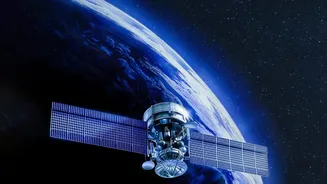
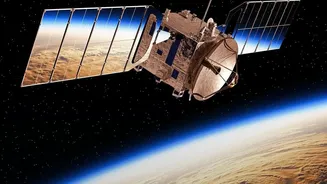
to change this fundamentally by giving satellites the ability to think for themselves. According to ISRO experts, integrating AI and machine learning (ML) will enable on-board data processing. Instead of sending down raw footage of a flooded region, a future satellite could analyze the imagery in orbit, identify the most affected areas, and transmit only that critical, actionable information. This capability, known as edge computing, means faster decision-making for disaster management, urban planning, and governance. ISRO chairman S. Somanath has emphasized the need for an AI-driven approach to analyze data more effectively, reducing unnecessary downloads and getting vital information to the ground faster. This extends to national security, where AI can help monitor borders and track changes with unprecedented speed and accuracy.
Making Satellites Autonomous
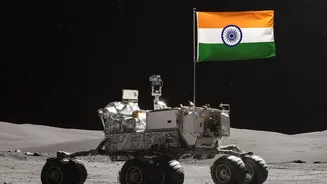
Beyond data analysis, AI will make spacecraft operations more autonomous and resilient. AI systems can monitor a satellite's health, predict potential system failures, and even make automatic course corrections to avoid space debris. With over a million debris objects larger than one centimetre currently orbiting Earth, this collision avoidance capability is crucial for protecting expensive assets and ensuring mission longevity. ISRO is also exploring AI for developing cost-effective, reusable launch vehicles and for managing complex tasks like tracking multiple objects in space. The AI-powered rover from the Chandrayaan-2 mission, designed to help navigate the lunar surface and identify minerals, was an early example of India's ambitions in this domain. By reducing the need for constant ground control, AI promises to make future space missions more efficient and robust.
The Quantum Leap: Securing the Future
If AI is the satellite's new brain, quantum technology is its impenetrable shield. Conventional encryption, which protects most of our digital data today, relies on mathematical problems that are difficult for classic computers to solve. However, future quantum computers could potentially break these codes. This is where Quantum Key Distribution (QKD) becomes a game-changer. QKD uses the principles of quantum physics to create encryption keys. Any attempt to eavesdrop on a QKD-protected signal disturbs the quantum state of the particles (photons), immediately alerting the sender and receiver. This makes the communication 'unhackable' by its very nature. ISRO has already successfully demonstrated free-space QKD over a distance of 300 meters, a major step toward creating a satellite-based quantum communication network (SBQC).
India's National Quantum Mission
This push is part of the broader National Quantum Mission (NQM), a government initiative launched in April 2023 with a budget of over ₹6,000 crore. A key goal of the mission is to establish satellite-based secure quantum communication between ground stations across a range of 2,000 kilometers within India. This will have profound implications for national security, securing military communications, and protecting critical infrastructure like banking, financial services, and stock markets from cyber threats. ISRO is aiming to launch its own QKD-enabled satellite within the next few years, a move that would place India in an elite group of nations with this advanced capability. Beyond communication, quantum sensors could also enable ultra-precise navigation and timing, further enhancing the capabilities of India's satellite systems.
A New Era for Indian Space Tech
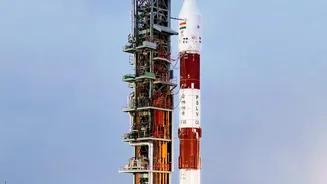
The convergence of AI and quantum systems represents a transformative moment for India's space program. AI will provide the intelligence to process vast amounts of data and operate satellites autonomously, while quantum technology will ensure that the data and communications are fundamentally secure. This synergy is critical for India's ambitions to expand its satellite fleet significantly for geo-intelligence gathering, with ISRO planning to launch 50 satellites in the coming five years for this purpose. These next-generation satellites will not only enhance India’s capabilities in earth observation, disaster management, and telecommunications but also solidify its position as a major global space power. By investing in these frontier technologies, India is not just planning for the next mission, but is building a secure and intelligent space infrastructure for decades to come.