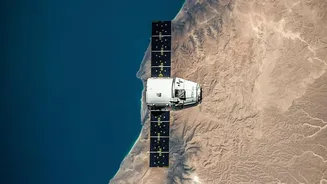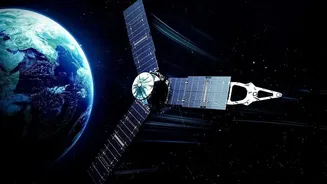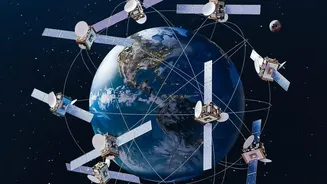









The dream of computing in the cosmos, a 'cloud' literally among the clouds, promised to solve Earth's data bottlenecks. Yet, the vision of vast orbital data networks remains more science fiction than business fact. So, what happened?
The Orbiting Dream
For years, the tech
industry has been captivated by a powerful idea: moving data centers into space. The concept, known as orbital computing, envisions vast networks of servers in low Earth orbit, powered by near-constant sunlight and cooled by the vacuum of space. Proponents argued this would solve major terrestrial problems. On Earth, data centers are power-hungry, requiring massive amounts of electricity for processing and cooling, and face increasing challenges with land use and grid capacity. In theory, space offers unlimited solar energy and a solution to these earthly constraints. This vision was championed by major players, with companies like Microsoft launching its Azure Space initiative and startups emerging with bold plans to create a truly global, high-performance computing grid above the planet.
The Harsh Reality of Space
Deploying giant networks in orbit has proven far more complex than conceptualizing them. The primary obstacles are both financial and physical. Firstly, the cost is astronomical. Despite advances from companies like SpaceX, launching the sheer mass of server racks required for a data center is prohibitively expensive. One estimate suggested a single server rack could cost up to $750,000 to launch. Secondly, space is an incredibly hostile environment for electronics. Terrestrial hardware isn't built to withstand the constant bombardment of cosmic radiation, which degrades components and causes errors. Furthermore, cooling is a paradoxical challenge. While space is cold, the vacuum prevents the use of air or liquid for convection cooling. Heat must be dissipated via large, heavy radiators, adding to launch mass and cost. Finally, once hardware is in orbit, maintenance or replacement is practically impossible, a stark contrast to the routine upgrades of ground-based centers.
From Grand Networks to Niche Solutions
In the face of these hurdles, the industry's focus has shifted. Instead of giant, all-purpose orbital networks, the emphasis is now on smaller, specialized 'edge' computing in space. Both Amazon's AWS and Microsoft's Azure have pivoted to providing cloud services that connect with satellites, rather than placing the entire cloud in orbit. Their work focuses on ground stations as a service and running specific software on existing satellites. For example, experiments have shown that processing data directly on an Earth-observation satellite can reduce the volume of data that needs to be sent back to the ground, saving bandwidth and time. Startups are also targeting these niche applications. Companies like OrbitsEdge, Sophia Space, and Starcloud are developing hardened computer hardware designed to run AI models and perform data analytics directly on a satellite, a concept sometimes called a 'space native' application platform. This approach doesn't replace terrestrial data centers but complements them by handling specific tasks closer to the source of data generation.
The Evolving Business Case
The dream of massive orbital data centers isn't entirely dead, but its timeline has been extended significantly. Some, like SpaceX and Google, are still pursuing long-term plans for large-scale orbital computing, driven by the explosive energy demands of AI that terrestrial grids may struggle to meet. However, even optimistic projections depend on launch costs falling dramatically, to perhaps under $100 per kilogram—a fraction of today's prices. For now, the viable business case lies in these smaller, edge applications. The goal is no longer to move the entire internet into the sky, but to bring intelligent processing to the satellite itself. This allows for faster insights from space-based sensors, improved connectivity in remote areas, and more efficient satellite operations. While some tests have taken place on the International Space Station and on dedicated satellites, these are still precursors, not widespread commercial deployments. As one AWS executive noted in early 2026, the idea of large-scale data centers in orbit is 'pretty far' from being economical or practical today.