




A Steamy Revelation
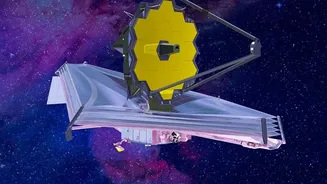
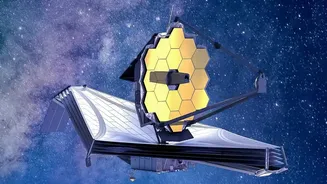
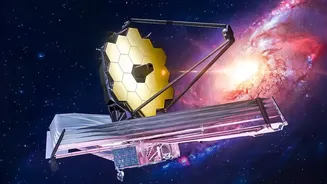
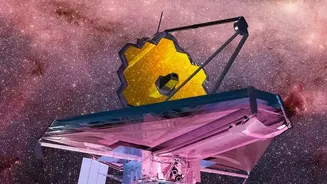
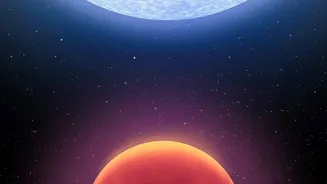
Scientists have confirmed the presence of a water-rich atmosphere on an exoplanet named GJ 9827 d, located about 97 light-years from Earth in the constellation Pisces. Using the unparalleled sensitivity of the James Webb Space Telescope, an international
team of researchers was able to analyze the light from the planet's host star as it filtered through the atmosphere. This technique, called transmission spectroscopy, revealed the definitive chemical fingerprint of water. The finding is significant as it's one of the smallest and first exoplanets of its kind, often called a 'steam world', where such a detection has been made, proving Webb's ability to probe the skies for the building blocks of life.
What is this Super-Earth?
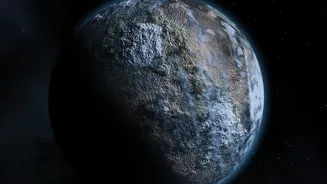
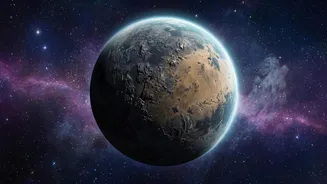
The term 'super-Earth' refers to planets that are larger than Earth but smaller than ice giants like Neptune. GJ 9827 d is roughly twice the diameter of our own planet. However, any resemblance to home ends there. This world orbits its star at a very close distance, completing a full year in just 6.2 Earth days. This proximity makes its surface incredibly hot, with temperatures estimated to be around 430 degrees Celsius (about 800 degrees Fahrenheit), similar to the planet Venus. Because of this intense heat, it is not a candidate for habitability as we know it; any water would exist only as a scorching, high-pressure steam.
The Significance of Finding Water
Finding water, even in the form of vapour on an inhospitable world, is a monumental achievement. For decades, planets with water-rich atmospheres were only theoretical. The discovery on GJ 9827 d provides concrete proof that such 'steam worlds' exist and, more importantly, that we have the technology to detect them. Until now, most atmospheres studied belonged to huge gas giants. This breakthrough demonstrates that Webb can successfully analyze the much thinner atmospheres of smaller, rockier planets—a crucial step toward one day studying a true Earth-twin. It confirms that a key ingredient for life is present in planetary systems beyond our own.
Not Earth 2.0, But a Vital Stepping Stone
It's important to manage expectations: GJ 9827 d is not a habitable paradise. Its broiling temperatures and crushing pressure mean it could never host liquid water on its surface. Instead of an oasis, it's more like a planetary-scale sauna. Scientists are considering two main possibilities for its origin: it could be a 'mini-Neptune' that lost its hydrogen atmosphere due to stellar radiation, leaving behind a denser, water-heavy core. Or it could have formed further out in its solar system, where water ice is plentiful, and migrated inwards over time. While not a candidate for life itself, its existence as a natural laboratory is invaluable.
What This Means for the Future
The detection of water vapour on GJ 9827 d serves as a powerful proof of concept. It sharpens the tools and techniques that astronomers will use to scrutinize other, more promising targets. The ultimate goal is to turn the JWST towards Earth-sized planets that orbit within their star's 'habitable zone'—the region where temperatures are just right for liquid water to exist. By successfully identifying an atmosphere on a small, hot world, scientists have crossed a major threshold. Now they know what to look for and are more confident they can find it on a planet that might genuinely support life. The search for habitable worlds just became much more plausible.