


What Did NASA's Study Uncover?
Researchers led by NASA's Goddard Space Flight Center found that certain microbes from Earth could temporarily survive the harsh lunar environment, but only in specific locations. The study, published in Science Advances, used computer models to simulate
conditions at the Moon's South Pole, an area of intense interest for future Artemis missions. The models showed that while microbes cannot grow or reproduce, they can enter a dormant state of suspended animation, known as cryptobiosis. This means they aren't dead, but they aren't active either; their cellular activity is paused until conditions potentially become more favorable.
The Key: Permanently Shadowed Craters
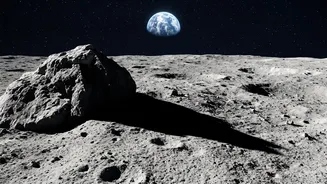
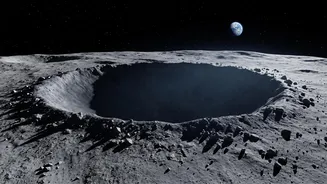
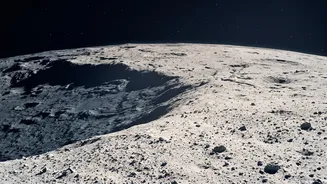
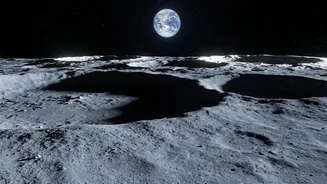
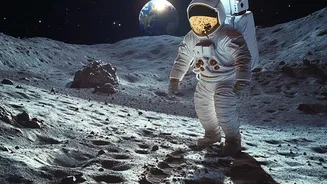
The secret to survival lies in the Moon's unique polar regions. Due to the Moon's minimal axial tilt, the sun's rays skim the surface at a low angle, never reaching the bottom of deep craters. These permanently shadowed regions (PSRs) are some of the coldest places in our solar system, with temperatures plunging as low as -200° Celsius. While most of the lunar surface is bombarded with lethal ultraviolet (UV) radiation and experiences extreme temperature swings, these shadowed craters offer protection. The models revealed that these 'survivable niches' could be as large as a crater floor or as small as an astronaut's bootprint, which can create its own tiny shadow.
Which Microbes Are the Toughest?
The study tested five types of microorganisms commonly found in spacecraft environments or on human skin. These included three bacterial strains and two fungal species known for their resilience. Fungi proved to be hardier than bacteria under the simulated lunar conditions. The standout survivor was a fungus called Aspergillus niger, a common black mould found in damp places on Earth, like bathrooms. It has even been found surviving on the exterior of the International Space Station. Its toughness is attributed to thick cell walls and an ability to repair its DNA even while dormant. The bacteria, including the famously radiation-resistant Deinococcus radiodurans, were found to be less resilient to the combined threats, especially UV radiation.
Implications for Planetary Protection
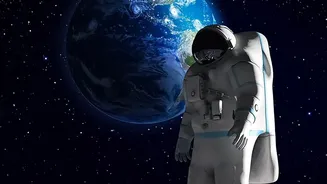
This finding has significant consequences for planetary protection—the practice of preventing biological contamination between Earth and other celestial bodies. Astronauts inevitably carry microbes with them; an average patch of human skin hosts millions of bacteria. If these microbes can survive on the Moon, they could contaminate scientific samples. This would make it difficult for scientists to know if any organic molecules they discover are truly native to the Moon or just hitchhikers from Earth. As NASA and other space agencies plan to establish a long-term presence on the Moon, understanding and tracking this contamination is crucial for preserving the integrity of lunar science. It's not that these microbes will start colonies, but their mere presence—dead or alive—can confuse the search for the Moon's original chemistry.
A Freezer for Earth's Past?
Beyond the contamination concerns, the study opens up a fascinating possibility. If microbes can survive in these polar cold traps, it's conceivable that the Moon might have been preserving biological material for eons. Some scientists speculate that asteroid impacts on ancient Earth could have launched rocks containing microbes into space, some of which may have landed on the Moon. If any of that material landed in a permanently shadowed crater, it could still be there, freeze-dried and waiting to be discovered. In this sense, the Moon could serve as a natural archive, holding frozen clues to the early history of life on our own planet. Future missions to these shadowed regions will need to be incredibly careful to distinguish between what they bring and what might already be there.