



The Sun's Inevitable Transformation
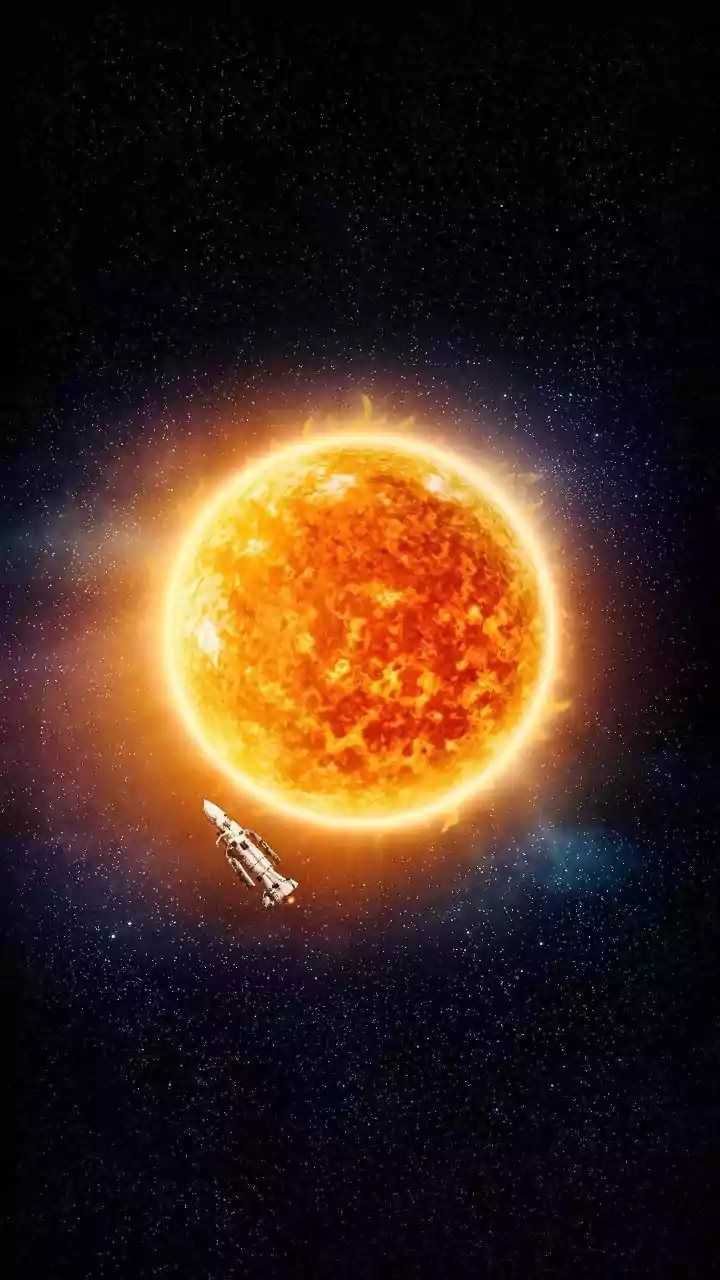
Our Sun, currently a middle-aged star, will not burn forever. In about five to six billion years, it will exhaust the hydrogen fuel in its core and begin a dramatic transformation. It will swell into a massive red giant, expanding its outer layers to a size
that will likely engulf Mercury, Venus, and possibly even Earth. After this phase, the Sun will shed its outer atmosphere, leaving behind an incredibly dense, hot stellar core called a white dwarf. For a long time, scientists believed this process would be relatively smooth, with the Sun losing about half its mass in a steady stream.
A Change in the Cosmic Dance
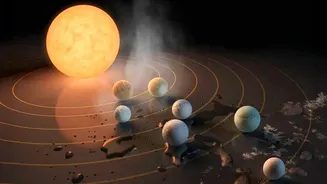
Previous models based on this smooth mass loss suggested a surprisingly stable future for the remaining planets. As the Sun's gravitational pull weakens, the orbits of the gas giants—Jupiter, Saturn, Uranus, and Neptune—were expected to expand outward but remain orderly. The prevailing theory was that the outer solar system could survive for a quintillion years (a billion billion years) before being disrupted by a passing star. This timeline is vastly longer than the current age of the universe itself. However, new research challenges this entire picture.
Introducing 'Stochastic Kicks'
The key insight from the new study, led by astrophysicists at the California Institute of Technology, is that the Sun won't die quietly. Instead of a smooth, gradual mass loss, it will likely shed its layers in violent, random bursts. These ejections, called 'stochastic kicks', will be unpredictable in both timing and direction. Each kick will nudge the dying Sun, subtly altering its gravitational influence on the planets. While a single kick might be insignificant, the cumulative effect of thousands of such bursts will introduce a powerful element of chaos into the system.
A Dramatically Shorter Lifespan
By running hundreds of simulations that incorporated these violent kicks, the researchers found a much grimmer and faster end for our planetary neighbourhood. The new models show that instead of a quintillion years, the outer planets are likely to become unstable and fall into disarray within a mere one billion years after the Sun becomes a white dwarf. That’s a reduction in the solar system's expected lifespan by a factor of a billion. In a significant number of simulations, the instability begins even before the Sun has fully transformed into a white dwarf, as the kicks start during its red giant phase.
The Final, Chaotic Picture
The end will not be orderly. The study predicts a future of cosmic billiards, where the gravitational nudges throw the giant planets into disarray. Their once-stable orbits could start to cross each other, leading to violent scattering. Some simulations showed Uranus and Neptune swapping places, while others resulted in planets being ejected from the solar system entirely, destined to become free-floating 'rogue' planets in the galaxy. In roughly 90% of the simulations, this chaotic breakdown happened within three billion years of the Sun becoming a white dwarf, rewriting our understanding of the solar system’s ultimate fate.