


An Unprecedented First Mission
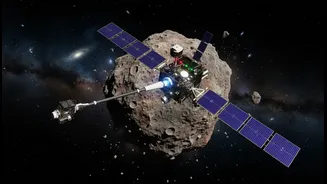
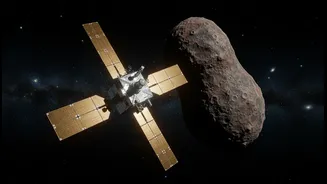
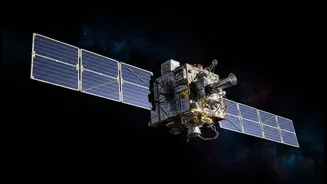
Launched in 2014 by the Japan Aerospace Exploration Agency (JAXA), Hayabusa2 had a clear objective: rendezvous with a C-type asteroid named Ryugu, collect pristine samples, and return them to Earth. These asteroids are cosmic time capsules, believed to hold
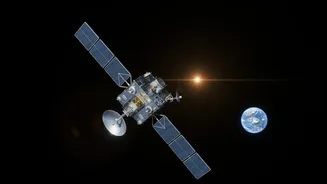
organic matter and water from the birth of our solar system 4.6 billion years ago. The mission was a stunning success. Hayabusa2 arrived at Ryugu in 2018, deployed rovers, and even created an artificial crater to collect subsurface material shielded from space weathering. In December 2020, it flew past Earth and dropped off its precious cargo—a capsule containing priceless grains of an asteroid—which has since provided profound insights into the building blocks of life.
A Second Life: The 'Hayabusa2#' Mission
Most missions would end there, but JAXA realised their spacecraft was still healthy and had about half of its xenon fuel remaining. Instead of decommissioning it, they gave it a new lease on life: an extended mission nicknamed 'Hayabusa2#'. This wasn't just an afterthought; it represents a strategic pivot. With its primary goals met, the spacecraft was redirected towards two new targets, transforming a successful mission into a long-term exploration platform. This decision maximises the return on the initial investment, using a proven, space-faring asset to conduct more science without the multi-billion dollar cost of building and launching a new probe.
Daring New Targets
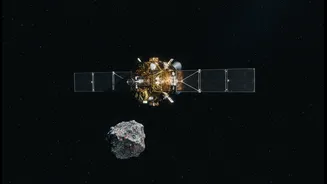
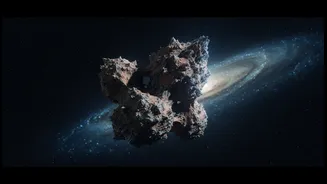
The extended mission is a multi-stage, decade-long odyssey. The first major event was a high-speed flyby of asteroid (98943) 2001 CC21, which successfully occurred in July 2026. Teams at JAXA pushed the aging craft to its limits, getting stunningly close images of the two-lobed asteroid. This encounter served as a crucial test of the spacecraft's capabilities and its team's ingenuity. But the grand finale is yet to come. After a pair of Earth swing-bys in 2027 and 2028 to adjust its trajectory, Hayabusa2 is set for a rendezvous with asteroid 1998 KY26 in July 2031. This target is an extreme challenge; it is a tiny, rapidly-rotating object only about 11-30 meters in diameter, roughly the size of the spacecraft itself. No probe has ever visited such a small body.
The Platform Philosophy
Hayabusa2 exemplifies a new, more sustainable philosophy in space exploration: treating successful spacecraft as adaptable platforms. Building and launching probes is incredibly expensive and time-consuming. By extending the lives of proven hardware, space agencies can conduct 'bonus' science at a fraction of the cost. This approach also allows for greater agility, enabling scientists to target newly discovered objects of interest. Furthermore, the Hayabusa2# mission serves as a vital training ground, allowing experienced engineers to pass their skills to a new generation on a live, long-duration mission. It also has direct implications for planetary defense, as studying small, fast-rotating asteroids like 1998 KY26 provides crucial data for how we might one day deflect a hazardous object.
A Blueprint for the Future
While missions like Voyager have had famously long lives, Hayabusa2's extension is more deliberate—a calculated plan to leverage an existing asset for new scientific and technological goals. It moves away from the bespoke, single-use model towards a more flexible and efficient paradigm. As humanity pushes farther into the solar system, the ability to repurpose and redeploy our robotic explorers will be critical. Missions like NASA's OSIRIS-REx, which also returned an asteroid sample, could potentially follow a similar path. The success of Hayabusa2 proves that a spacecraft's value doesn't have to end when its primary mission does. It can become a launchpad for the next wave of discovery.